Within Flexible Compute
Who Should Pay AI Data Centres to Flex?
Flexible computing only works at scale when contracts reward operators, verify reductions and protect customers from service failures.
On this page
- Why idle GPUs need financial compensation
- How utilities can verify promised load reductions
- Rules for sharing savings and protecting customers
Page outline Jump by section
Introduction
If AI data centres are expected to reduce their electricity demand when the grid is under stress, someone has to pay for that flexibility. Cutting power to thousands of GPUs is not free. It can delay AI training, reduce computing revenue, require sophisticated control software, and increase operational complexity. If grid operators want data centres to behave as dependable balancing resources rather than inflexible electricity users, they generally need to compensate them for providing that service.
The key policy question is therefore not whether flexible computing is technically possible, but how markets should reward it. Well-designed incentives can encourage data centres to help absorb renewable energy, avoid expensive network upgrades and reduce the need for emergency power plants. Poorly designed incentives could simply transfer costs to electricity customers without delivering reliable benefits. For an AI-enabled future that aims to expand abundance rather than merely consume more energy, the economics of flexibility matter as much as the technology.
Why idle GPUs need financial compensation
A flexible AI data centre gives up something valuable whenever it reduces demand.
During a grid stress event, an operator might postpone an AI training run, lower GPU power limits or migrate work to another region. Although these actions can preserve critical customer services, they still impose costs. They may reduce utilisation of expensive hardware, delay project completion, increase software management costs or require spare capacity elsewhere.
That creates a straightforward economic principle: flexibility should be treated as a grid service rather than a charitable contribution.
Electricity systems already pay many other participants for providing reliability. Power stations receive payments for being available in some capacity markets even if they generate little electricity. Batteries earn revenue by responding rapidly to changing grid conditions. Large factories can receive demand-response payments for temporarily reducing consumption during shortages. Flexible data centres fit naturally into the same family of services rather than requiring an entirely new market.[Federal Energy Regulatory Commission]ferc.govFederal Energy Regulatory CommissionUnderstanding Wholesale Capacity Markets | Federal Energy Regulatory CommissionJune 2, 2026…
Without compensation, operators would usually have stronger incentives simply to maximise computing output. Since modern AI accelerators cost millions of pounds to install and are expected to run at high utilisation, voluntarily leaving them idle during profitable periods is rarely commercially attractive.
Who ultimately pays?
The answer depends on which electricity market is purchasing the flexibility, but the immediate payer is rarely the taxpayer.
Several arrangements already exist.
- Grid operators may procure demand-response services to help maintain system reliability during periods of unusually high demand.
- Distribution network operators may pay flexible customers to reduce local congestion instead of immediately reinforcing substations or cables.
- Electricity suppliers or retailers may reward customers for shifting demand away from expensive periods.
- Capacity markets may compensate resources that commit to reducing demand when required, treating demand reduction as an alternative to building additional generation.
Although these payments come from different market mechanisms, the costs are generally recovered through electricity charges spread across users of the electricity system. The rationale is that paying some consumers to become flexible can be cheaper than building rarely used infrastructure or operating expensive emergency generation.[ferc.gov]ferc.govFederal Energy Regulatory CommissionUnderstanding Wholesale Capacity Markets | Federal Energy Regulatory CommissionJune 2, 2026…
The economic question is therefore comparative rather than absolute: is paying a data centre to reduce demand cheaper than the alternatives?
Why verification matters as much as payment
A promise to reduce electricity demand has value only if system operators can trust it.
Demand-response programmes therefore rely on detailed measurement and verification.
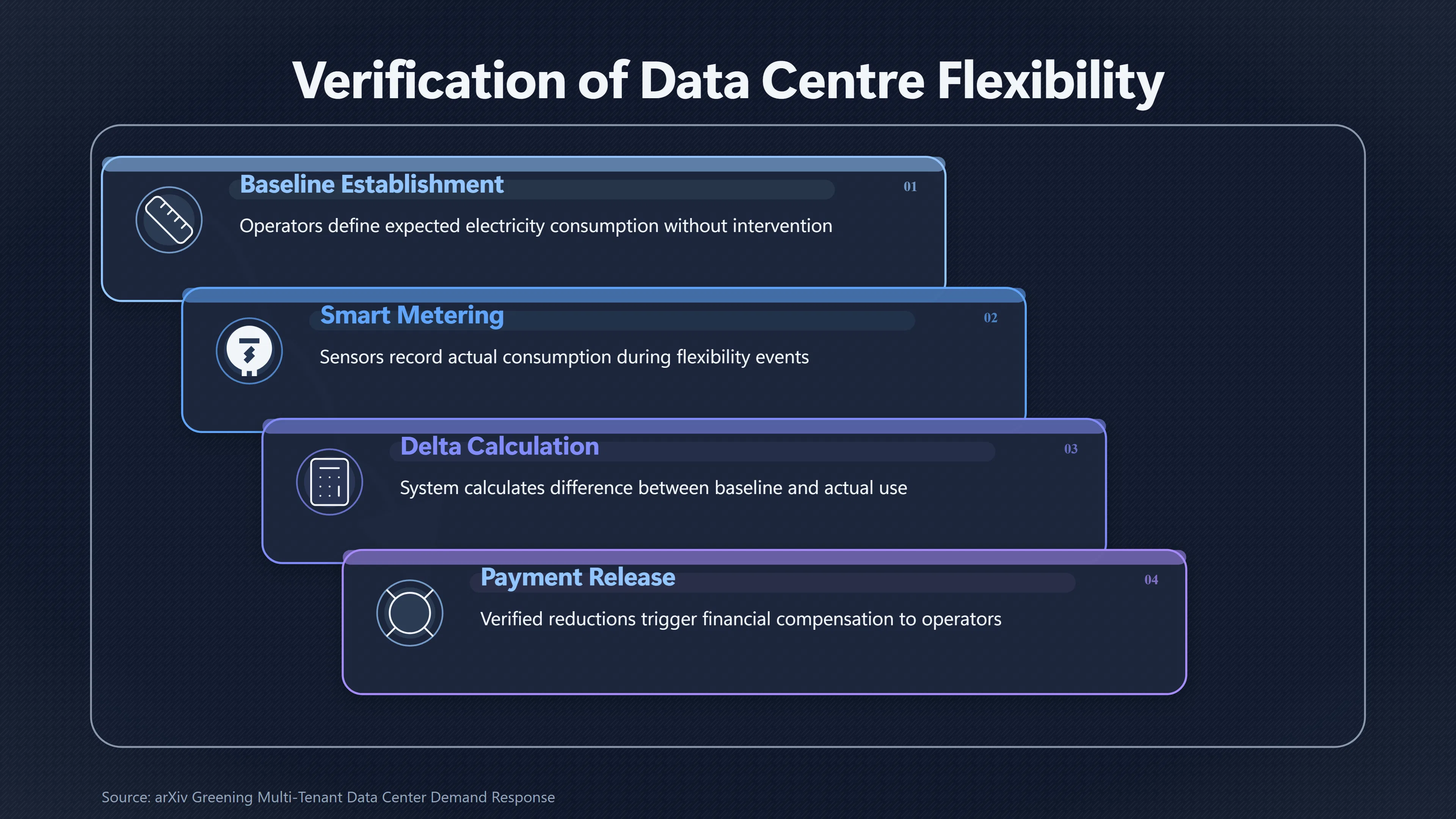
Typically this requires operators to establish a baseline showing how much electricity the facility would have consumed without intervention. Smart metering then records actual consumption during a flexibility event. The difference between the baseline and measured demand determines the amount of flexibility delivered.
Verification also needs to answer practical questions.
- Did the data centre reduce demand quickly enough?
- Was the reduction sustained for the contracted period?
- Did it simply shift electricity use to another nearby site?
- Were customer service guarantees maintained?
- Can the response be repeated reliably throughout the year?
Only verified reductions should receive payment. Otherwise, markets risk paying for flexibility that exists only on paper.
Recent demonstrations of AI-controlled workload management have helped strengthen confidence because they show software automatically responding to grid signals while maintaining agreed computing performance. Such trials provide evidence that flexibility can be measured rather than merely claimed.[National Grid]nationalgrid.comOpen source on nationalgrid.com.

Different services deserve different prices
Not every reduction in electricity demand has equal value.
Electricity markets increasingly distinguish between several kinds of flexibility.
Emergency demand response commands the highest value because it helps avoid blackouts during rare but critical periods.
Network congestion management rewards customers that relieve local bottlenecks, allowing utilities to postpone reinforcement of cables, transformers or substations.
Energy price arbitrage allows data centres to shift flexible computing into hours when wholesale electricity prices are lower or renewable generation is abundant.
Capacity services reward participants simply for remaining available to reduce demand if needed, regardless of whether they are called upon frequently.
Academic work has proposed even more sophisticated approaches for AI facilities. Instead of viewing a data centre purely as a consumer of electricity, researchers suggest treating geographically distributed computing as a provider of “space-time” flexibility, where workloads move between locations or time periods in response to electricity prices and grid needs. In those models, compensation reflects the value created by shifting demand across both time and place.[arXiv]arxiv.orgRemunerating Space-Time, Load-Shifting Flexibility from Data Centers in Electricity MarketsMay 24, 2021…
Sharing the savings fairly
One of the hardest governance questions is how the financial benefits should be divided.
Suppose paying a data centre £1 million per year for flexibility allows a utility to avoid a £20 million network upgrade that would otherwise be recovered from electricity customers over many years.
Several stakeholders have legitimate claims on those savings.
- The data-centre operator invested in software, operational processes and contractual risk.
- The utility or network operator avoided infrastructure costs.
- Electricity customers funded the flexibility payments through network charges and should benefit from lower long-term costs.
- Cloud customers may have accepted delayed batch processing or other operational constraints.
Poorly designed incentives could overpay data centres for modest flexibility or allow benefits to accrue mainly to operators while consumers see little reduction in electricity bills.
Competitive procurement helps address this problem. Rather than negotiating individually with each operator, utilities can invite multiple providers—including batteries, factories, commercial buildings and data centres—to compete to provide flexibility. Competition encourages payments to reflect the actual market value of the service rather than the bargaining power of individual firms.[Distribution System Operator (DSO)]dso.nationalgrid.co.ukDistribution System Operator (DSO)National Grid DSOFlexibility markets…
Protecting AI customers
Grid flexibility should not quietly undermine the reliability that cloud customers expect.
Most AI facilities support a mixture of workloads with different tolerance for delay.
Interactive AI assistants, medical systems and financial services often require immediate responses. Large training jobs, data processing pipelines and background optimisation tasks may tolerate pauses or slower execution.
Contracts therefore need clear service-level agreements specifying which workloads may be interrupted, how long interruptions may last and what compensation customers receive if promised performance is not delivered.
Earlier research on cloud computing highlighted another challenge: tenants often have little incentive to make their own workloads flexible unless they receive part of the financial benefit. Proposed pricing mechanisms therefore reward customers that voluntarily allow longer completion deadlines, aligning incentives throughout the computing stack rather than concentrating them solely at the data-centre operator.[arXiv]arxiv.orgExtending Demand Response to Tenants in Cloud Data Centers via Non-intrusive Workload Flexibility PricingMarch 18, 2016…
Policy choices that could make flexibility routine
Several policy changes could make flexible AI computing a standard part of electricity systems rather than an occasional demonstration.
First, regulators can ensure that demand reduction competes fairly with electricity generation and storage in wholesale markets. In several jurisdictions, demand response already receives comparable treatment when it can reliably substitute for generation.[Federal Energy Regulatory Commission]ferc.govOpen source on ferc.gov.
Second, network operators can publish transparent local flexibility needs and procure services through competitive auctions instead of relying solely on traditional infrastructure investment. UK distribution operators are already expanding local flexibility markets for this purpose.[Distribution System Operator (DSO)]dso.nationalgrid.co.ukDistribution System Operator (DSO)National Grid DSOFlexibility markets…
Third, interconnection agreements for new AI facilities could include contractual flexibility commitments. Rather than requiring every data centre to receive enough capacity for its absolute peak demand under all conditions, operators willing to reduce demand during constrained periods may obtain faster or more economical grid connections. This idea is increasingly being explored alongside broader reforms to accommodate rapidly growing AI electricity demand.[ferc.gov]ferc.govOpen source on ferc.gov.
Why these incentives matter for AI-enabled abundance
Within the broader vision of AI supporting long-term human flourishing, flexible data centres illustrate an important principle: software can sometimes substitute for physical infrastructure.
The direct payments made to flexible data centres are not a subsidy for AI itself. They are payments for a measurable reliability service that may reduce overall system costs if designed well. When flexibility genuinely postpones expensive network expansion, reduces renewable energy curtailment or avoids emergency generation, electricity consumers can benefit alongside AI operators.
Whether that outcome is realised depends on governance rather than technology alone. Markets must verify genuine load reductions, reward performance rather than promises, distribute savings fairly and protect both electricity consumers and cloud customers. If those conditions are met, flexible AI facilities could become another tool that helps electricity systems support a larger, cleaner and more capable digital economy without assuming that ever-growing demand must always be met by building more generation first.
Amazon book picks
Further Reading
Books and field guides related to Who Should Pay AI Data Centres to Flex?. Use these as the next step if you want deeper reading beyond the article.
Energy and Civilization: A History
A comprehensive account of how energy has shaped society throughout history, from pre-agricultural foraging societies through today's fos...
The Big Switch: Rewiring the World, from Edison to Google
“Magisterial…Draws an elegant and illuminating parallel between the late-19th-century electrification of America and today’s computing wo...
The Grid: The Fraying Wires Between Americans and Our Energy...
One of Bill Gates's Favorite Books of 2016 A revelatory look at our national power grid--how it developed, its current flaws, and how it...
eBay marketplace picks
Marketplace Samples
Live-tested eBay searches with available results related to this page.
Selected fromserver rack model oneBay.co.uk.

![Listing image for Dell PowerEdge R730xd 16LFF+2SFF Server /IndigoVision NVR-AS 4000/32GB RAM [16D]](/assets/images/marketplace-covers/18895e58d071ea980a50.jpg)
Endnotes
1.
Source: arxiv.org
Link:https://arxiv.org/abs/2511.07159
2.
Source: arxiv.org
Link:https://arxiv.org/abs/2105.11416
Source snippet
Remunerating Space-Time, Load-Shifting Flexibility from Data Centers in Electricity MarketsMay 24, 2021...
Published: May 24, 2021
3.
Source: arxiv.org
Link:https://arxiv.org/abs/1603.05746
Source snippet
Extending Demand Response to Tenants in Cloud Data Centers via Non-intrusive Workload Flexibility PricingMarch 18, 2016...
Published: March 18, 2016
4.
Source: arxiv.org
Title: arXiv Greening Multi-Tenant Data Center Demand Response
Link:https://arxiv.org/abs/1504.07308
5.
Source: reuters.com
Link:https://www.reuters.com/business/energy/big-tech-power-grids-take-action-reign-surging-demand-2025-08-18/
Source snippet
To manage stress on the grid, utilities are implementing rate changes and market tools, while tech companies like Microsoft and AWS are a...
6.
Source: reuters.com
Link:https://www.reuters.com/business/energy/uks-ofgem-proposes-grid-connection-fee-deter-speculative-data-centre-projects-2026-07-29/
7.
Source: ferc.gov
Link:https://www.ferc.gov/understanding-wholesale-capacity-markets
Source snippet
Federal Energy Regulatory CommissionUnderstanding Wholesale Capacity Markets | Federal Energy Regulatory CommissionJune 2, 2026...
Published: June 2, 2026
8.
Source: ferc.gov
Link:https://ferc.gov/power-sales-and-markets/demand-response
9.
Source: dso.nationalgrid.co.uk
Title: Distribution System Operator (DSO)National Grid DSO
Link:https://dso.nationalgrid.co.uk/flexibility-markets
Source snippet
Flexibility markets...
10.
Source: GOV.UK
Title: Capacity Market: consumer-led flexibility (HTML)
Link:https://www.gov.uk/government/calls-for-evidence/capacity-market-consumer-led-flexibility/capacity-market-consumer-led-flexibility-html
11.
Source: nationalgrid.com
Link:https://www.nationalgrid.com/uk-first-trial-ai-grid-technology-successfully-demonstrates-ability-data-centres-adjust-power-needs
12.
Source: dso.nationalgrid.co.uk
Title: Distribution System Operator (DSO)National Grid DSO
Link:https://dso.nationalgrid.co.uk/flexibility-markets/earnings-and-use-cases
Source snippet
Earnings and use cases...
13.
Source: ferc.gov
Link:https://www.ferc.gov/news-events/news/ferc-launches-aggressive-targeted-action-speed-large-load-integration
14.
Source: ofgem.gov.uk
Title: capacity market rules change proposals 2026
Link:https://www.ofgem.gov.uk/consultation/capacity-market-rules-change-proposals-2026
15.
Source: GOV.UK
Link:https://www.gov.uk/government/publications/contracts-for-difference-and-capacity-market-scheme-update-2025/contracts-for-difference-and-capacity-market-scheme-update-2025-[accessible
16.
Source: GOV.UK
Title: statutory security of supply report 2025
Link:https://www.gov.uk/government/publications/statutory-security-of-supply-report-2025/statutory-security-of-supply-report-2025
17.
Source: ferc.gov
Link:https://ferc.gov/power-sales-and-markets/demand-response/reports-demand-response-and-advanced-metering
18.
Source: GOV.UK
Title: contracts for difference and capacity market scheme update 2024
Link:https://www.gov.uk/government/publications/contracts-for-difference-and-capacity-market-scheme-update-2024/contracts-for-difference-and-capacity-market-scheme-update-2024
Additional References
19.
Source: youtube.com
Title: Data center power crisis: who pays for AI’s energy?
Link:https://www.youtube.com/watch?v=ynC1uSOvSHs
Source snippet
Can Data Centers Actually Lower Your Electric Bill?...
20.
Source: youtube.com
Title: Can Data Centers Actually Lower Your Electric Bill?
Link:https://www.youtube.com/watch?v=HwS4yWgUXL4
Source snippet
How Texas decides which data centers to connect...
21.
Source: youtube.com
Title: How Texas decides which data centers to connect
Link:https://www.youtube.com/watch?v=sFuoq344UKI
Source snippet
Powering the Data Center Boom Responsibly...
22.
Source: youtube.com
Title: Powering the Data Center Boom Responsibly
Link:https://www.youtube.com/watch?v=jG2wSAHTM_A