Within Trusted Access
Will Free AI Tutors Be Good Enough?
Unequal access to better models, safer data practices and stronger learning design could turn AI tutoring into a new source of educational inequality.
On this page
- How tutor quality may divide by income
- The hidden costs of advertising and learner data
- What a credible public alternative must guarantee
Page outline Jump by section
Introduction
Free AI tutors could become one of the most powerful tools ever created for widening access to education. A learner with a smartphone can already receive explanations, practise languages, solve maths problems and explore unfamiliar subjects at any time of day. Within the broader vision of AI supporting long-term human flourishing, this ability to make personalised teaching widely available is one of the strongest arguments that advanced AI could expand human potential rather than merely automate existing work.

Yet the same technology could also create a new educational divide. If wealthier learners receive sophisticated, privacy-preserving tutors built around learning science while everyone else relies on free systems funded by advertising, trained on user data or optimised mainly for engagement, AI could reinforce inequality instead of reducing it. The central question is therefore not whether free AI tutors exist, but whether they are good enough to provide genuinely equal educational opportunity. UNESCO, the OECD and many education researchers argue that equitable access depends as much on governance, pedagogy and public policy as on model capability.[unesco.org]unesco.orgguidance generative ai education and researchGuidance for generative AI in education and research | UNESCOSeptember 7, 2023…
How tutor quality may divide by income
The most obvious risk is that AI tutoring follows a familiar digital pattern: a capable free version for everyone, and a substantially better version reserved for paying subscribers.
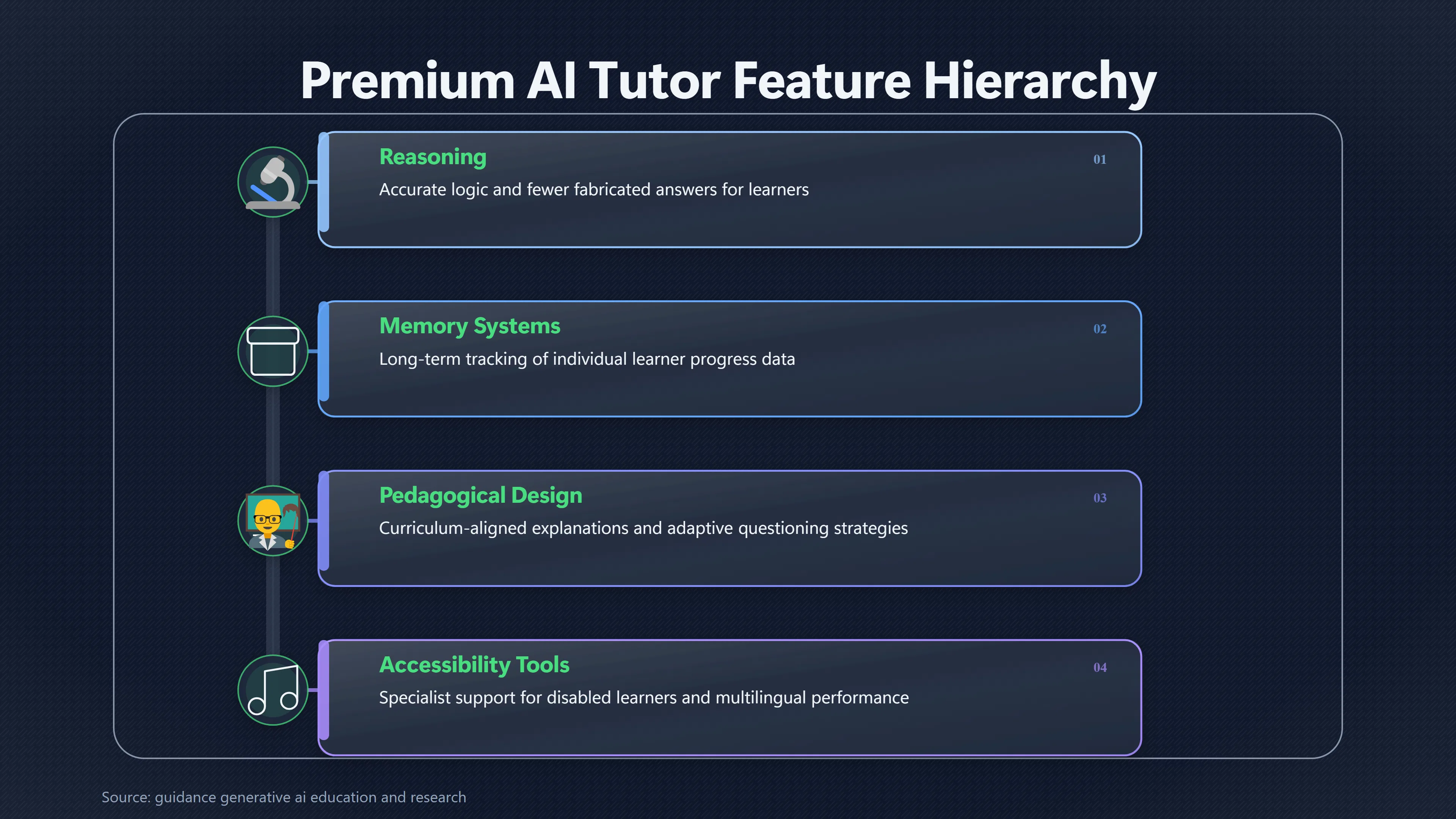
The gap may not simply involve faster responses or larger models. Premium educational AI could offer features that directly affect learning outcomes, including:
- more accurate reasoning and fewer fabricated answers;
- longer-term memory of a learner’s progress;
- curriculum-aligned explanations;
- adaptive questioning rather than direct answer generation;
- specialist support for difficult subjects;
- stronger accessibility tools for disabled learners;
- better multilingual performance;
- lower latency and greater availability during periods of heavy demand.
These differences matter because educational value depends less on producing correct answers than on helping learners develop understanding. The OECD’s Digital Education Outlook argues that general-purpose chatbots often improve immediate task performance without necessarily producing lasting learning gains. In contrast, AI systems deliberately designed around educational principles, questioning strategies and teacher expertise appear much more promising.[oecd.org]oecd.orgoecd digital education outlook 2026 062a7394 enOECD Digital Education Outlook 2026 | OECD…
This creates a subtle form of inequality. Two students may both appear to have “free AI”, yet one receives a system that patiently diagnoses misconceptions and encourages productive struggle, while the other receives a conversational assistant that mostly supplies answers. Over months or years, those differences could accumulate into substantial gaps in knowledge, confidence and independent thinking.
The hidden costs of “free”
Unlike publicly funded education, commercial free services rarely operate without an economic model. If users do not pay directly, providers typically recover costs through other means.
In education, those hidden costs may include:
- extensive collection of learner interaction data;
- personalised advertising or commercial partnerships;
- incentives to maximise engagement rather than understanding;
- pressure to upsell premium subscriptions;
- reduced transparency about how educational recommendations are generated.
Learner conversations reveal unusually sensitive information. Students often disclose weaknesses, anxieties, career ambitions, health concerns or family circumstances while asking for help. A system designed primarily as an educational service should therefore treat these interactions differently from ordinary consumer chatbots.
UNESCO has warned that many countries still lack comprehensive regulatory frameworks governing generative AI in education, leaving learner privacy insufficiently protected. Its guidance argues that educational AI should adopt human-centred safeguards, transparent governance and robust protection of children’s data rather than relying on commercial norms developed for general online services.[unesco.org]unesco.orgguidance generative ai education and researchGuidance for generative AI in education and research | UNESCOSeptember 7, 2023…
The risk is not simply targeted advertising. Rich educational profiles could influence future recruitment, financial products or other services if governance is weak. Even where misuse never occurs, uncertainty about data handling may discourage learners from asking sensitive questions that are essential for effective education.
Quality is about pedagogy, not just smarter models
Public discussion often assumes that educational quality rises automatically as AI becomes more capable. Research suggests the picture is more complicated.
Learning science consistently shows that durable understanding depends on retrieval practice, feedback, spaced repetition, reflection and gradual development of mental models. A tutor that simply provides polished answers may feel impressive while actually reducing learning.
The OECD warns that successful completion of AI-assisted tasks should not be confused with genuine understanding. Some studies reviewed in its 2026 outlook found that students using general-purpose AI produced better coursework yet failed to retain corresponding knowledge when later assessed without AI support. Educational systems designed with explicit pedagogical goals performed more consistently because they encouraged reasoning instead of replacing it.[oecd.org]oecd.orgoecd digital education outlook 2026 062a7394 enOECD Digital Education Outlook 2026 | OECD…
This means educational inequality may increasingly depend on instructional design rather than raw computing power. Premium services may invest heavily in cognitive science, teacher collaboration and rigorous evaluation, while lower-cost alternatives rely on generic conversational models with relatively little educational adaptation.
Why disadvantaged learners face greater risks
Educational inequality rarely stems from a single missing technology. Instead, multiple disadvantages reinforce one another.
Learners with fewer resources are often more likely to experience:
- unreliable internet access or older devices;
- less access to teachers or private tutors;
- fewer quiet study environments;
- lower levels of digital literacy;
- weaker support for evaluating incorrect AI responses.
In these circumstances, lower-quality AI tutors can become especially problematic. A learner who already lacks expert guidance may have little opportunity to recognise inaccurate explanations, challenge misleading advice or develop effective prompting skills.
Ironically, the people who could benefit most from AI tutoring are also those who may be most vulnerable if the free systems available to them are less accurate, less transparent or less carefully designed.
The danger of a new educational status hierarchy
Historically, educational inequality has often reflected unequal access to teachers, books, universities or private tuition. AI introduces a different possibility: unequal access to intelligence itself.
Imagine two adults retraining for new careers after automation changes the labour market.
One has access to a sophisticated AI tutor that remembers previous lessons, identifies misconceptions, generates personalised exercises and collaborates with human instructors.
The other relies on a free chatbot that frequently forgets context, offers inconsistent explanations, interrupts learning with commercial prompts or limits advanced features behind subscription tiers.
Both technically possess an AI tutor, yet their learning experience differs dramatically.
If advanced AI becomes an increasingly important partner in acquiring knowledge throughout life, differences in tutor quality could influence career mobility, income and civic participation. In a future where continual reskilling becomes normal, educational AI could become as important as access to quality schools is today.
What a credible public alternative must guarantee
Avoiding a two-tier system does not necessarily require governments to prohibit commercial AI tutors. It does require ensuring that every learner has access to trustworthy alternatives that meet minimum educational standards.
A credible public AI tutoring service would ideally guarantee:
- Educational quality. Systems should be grounded in established learning science rather than engagement metrics alone.
- Privacy by design. Learner conversations should not become commercial advertising assets.
- Transparency. Users should understand how answers are generated, where uncertainty exists and how information can be verified.
- Accessibility. High-quality support should extend to disabled learners, minority languages and varying literacy levels.
- Curriculum alignment. Tutors should complement recognised educational goals while remaining useful for lifelong learning beyond formal schooling.
- Human accountability. Teachers, librarians and educational institutions should remain responsible for oversight, appeals and continuous improvement.
- Independent evaluation. Public evidence should demonstrate whether AI tutors actually improve learning rather than simply increasing task completion.
UNESCO has also supported principles for public digital learning platforms that emphasise openness, equity, inclusion and public accountability. These principles recognise that educational technology functions differently from ordinary consumer software because its social purpose is to expand knowledge rather than maximise engagement or revenue.[unesco.org]unesco.orgguidance generative ai education and researchGuidance for generative AI in education and research | UNESCOSeptember 7, 2023…
Why this matters for AI Bloom
The optimistic case for AI Bloom depends on intelligence becoming broadly available, not merely more powerful. If advanced AI allows millions of people to learn new scientific, technical and creative skills throughout their lives, the resulting expansion of human capability could accelerate discovery, productivity and cultural flourishing.
A two-tier tutoring system would weaken that vision. Instead of making intelligence more abundant, it could make high-quality cognitive support another scarce resource distributed by income, geography or commercial incentives.
The policy challenge is therefore not simply to make AI tutors free. It is to ensure that free access also means trustworthy access: educationally effective, privacy-respecting and available to everyone. If societies can achieve that standard, AI tutoring could become a modern equivalent of the public library—an institution that expands opportunity across generations rather than concentrating it among those already best served.
Amazon book picks
Further Reading
Books and field guides related to Will Free AI Tutors Be Good Enough?. Use these as the next step if you want deeper reading beyond the article.
Reclaiming Conversation
“[Turkle] presents a powerful case that a new communication revolution is degrading the quality of human relationships.” —The New York Re...
The Wealth of Networks
Describes how patterns of information, knowledge, and cultural production are changing. The author shows that the way information and kno...
The Digital Divide
Contrary to optimistic visions of a free internet for all, the problem of the ‘digital divide’ – the disparity between those with access...
The Shallows
Finalist for the 2011 Pulitzer Prize in General Nonfiction: “Nicholas Carr has written a Silent Spring for the literary mind.”—Michael Ag...
eBay marketplace picks
Marketplace Samples
Live-tested eBay searches with available results related to this page.
Selected fromeducation technology poster oneBay.co.uk.




Endnotes
1.
Source: unesco.org
Title: guidance generative ai education and research
Link:https://www.unesco.org/en/articles/guidance-generative-ai-education-and-research?hub=67098
Source snippet
Guidance for generative AI in education and research | UNESCOSeptember 7, 2023...
Published: September 7, 2023
2.
Source: oecd.org
Title: oecd digital education outlook 2026 062a7394 en
Link:https://www.oecd.org/en/publications/oecd-digital-education-outlook-2026_062a7394-en.html
Source snippet
OECD Digital Education Outlook 2026 | OECD...
3.
Source: oecd.org
Title: 062a7394 en
Link:https://www.oecd.org/content/dam/oecd/en/publications/reports/2026/01/oecd-digital-education-outlook-2026_940e0dd8/062a7394-en.pdf
4.
Source: unesco.org
Title: Artificial intelligence in education
Link:https://www.unesco.org/en/digital-education/artificial-intelligence?hub=66708
Source snippet
AI | UNESCOARTIFICIAL INTELLIGENCE IN EDUCATION Artificial Intelligence (AI) has the potential to address some of the biggest challenges...
5.
Source: oecd.org
Title: How to effectively use Generative AI in education
Link:https://www.oecd.org/en/blogs/2026/01/how-to-effectively-use-generative-ai-in-education.html
Source snippet
January 19, 2026 — HOW TO EFFECTIVELY USE GENERATIVE AI IN EDUCATION Blog 3 min read 19 January 2026 Available in: English * English * fr...
Published: January 19, 2026
6.
Source: oecd.org
Link:https://www.oecd.org/en/publications/2023/12/oecd-digital-education-outlook-2023_c827b81a/full-report/opportunities-guidelines-and-guardrails-for-effective-and-equitable-use-of-ai-in-education_2f0862dc.html
Source snippet
Opportunities, guidelines and guardrails for effective and equitable use of AI in education: OECD Digital Education Outlook 2023 | OECDDe...
7.
Source: oecd.org
Title: emerging governance of generative ai in education 3cbd6269
Link:https://www.oecd.org/en/publications/oecd-digital-education-outlook-2023_c74f03de-en/full-report/emerging-governance-of-generative-ai-in-education_3cbd6269.html
Source snippet
EMERGING GOVERNANCE OF GENERATIVE AI IN EDUCATION Copy link to 10. Emerging governance of generative AI in education Quentin Vidal OECD S...
8.
Source: digital-education-outlook.oecd.org
Link:https://digital-education-outlook.oecd.org/
Source snippet
Digital Education Outlook 2021 – OECD Digital Education Outlook 2021OECD DIGITAL EDUCATION OUTLOOK 2021 PUSHING THE FRONTIERS WITH AI, BL...
9.
Source: unesco.org
Title: Artificial intelligence in education
Link:https://www.unesco.org/en/digital-education/artificial-intelligence?hub=83250
Source snippet
AI | UNESCOARTIFICIAL INTELLIGENCE IN EDUCATION Artificial Intelligence (AI) has the potential to address some of the biggest challenges...
10.
Source: unesco.org
Title: Artificial intelligence in education
Link:https://www.unesco.org/en/digital-education/artificial-intelligence?hub=67832
Source snippet
AI | UNESCOARTIFICIAL INTELLIGENCE IN EDUCATION Artificial Intelligence (AI) has the potential to address some of the biggest challenges...
11.
Source: iicba.unesco.org
Title: It supports immediate
Link:https://www.iicba.unesco.org/en/africa-education-knowledge-platform/guidance-generative-ai-education-and-research
Source snippet
for generative AI in education and research - Africa Education Knowledge PlatformGUIDANCE FOR GENERATIVE AI IN EDUCATION AND RESEARCH * *...
Additional References
12.
Source: oecd-events.org
Title: effective uses of generative ai in education
Link:https://www.oecd-events.org/e/effective-uses-of-generative-ai-in-education
Source snippet
OECD Digital Education Conference: Exploring Effective Uses of Generative AI in EducationOECD Digital Education Outlook 2026 Conference E...
13.
Source: oecd-events.org
Title: launch of the 2026 digital education outlook
Link:https://www.oecd-events.org/e/smart-data-and-digital-technology-in-education/session/79e41820-b13f-f111-8ef2-6045bd954320/-launch-of-the-2026-digital-education-outlook
Source snippet
January 20, 2026 — LAUNCH OF THE 2026 DIGITAL EDUCATION OUTLOOK Jan 20, 2026 | 9:00 AM - 11:00 AM Digital Education Outlook 2026 Watch th...
Published: January 20, 2026
14.
Source: youtube.com
Title: Andy Rotherham: Why AI Makes Knowing Things Matter More
Link:https://www.youtube.com/watch?v=dmUhbFxQ-yM
Source snippet
How AI could save (not destroy) education | Sal Khan...
15.
Source: youtube.com
Title: Rich Kids Learning Years Ahead With AI Tutors
Link:https://www.youtube.com/watch?v=iKY3Q9oBXL8
Source snippet
Andy Rotherham: Why AI Makes Knowing Things Matter More...
16.
Source: youtube.com
Title: AI, Access, and the Educational Divide
Link:https://www.youtube.com/watch?v=zyAsDHcQ96I
Source snippet
UNESCO Guidance for generative AI in education and research...
17.
Source: youtube.com
Title: How AI could save (not destroy) education | Sal Khan
Link:https://www.youtube.com/watch?v=aropfD2GzXA
Source snippet
AI, Access, and the Educational Divide...
18.
Source: youtube.com
Title: UNESCO Guidance for generative AI in education and research
Link:https://www.youtube.com/watch?v=rnBvr7IAvic