Within Labour Share
Can Workers Share AI's New Wealth
If AI-generated wealth becomes concentrated among asset owners, ownership and institutional choices may shape whether workers share in future gains.
On this page
- Why ownership matters in automation
- Models for broader participation
- Trade offs in changing incentives
Page outline Jump by section
Introduction
If advanced AI creates enormous new wealth but ownership remains concentrated among a small group of companies and investors, the central question is not only how much wealth is produced, but who has a lasting claim on it. Worker ownership responses argue that people who contribute labour to an AI-enabled economy should also share in the assets that make that economy productive.
This does not mean every worker must directly own part of every AI system. The broader idea is that societies can redesign ownership so that productivity gains from automation flow partly through wages, partly through shared capital ownership, and partly through public institutions. Employee ownership schemes, worker cooperatives, profit-sharing, and proposals for collective AI wealth funds all attempt to address the same problem: avoiding a future where AI abundance exists but economic power becomes increasingly detached from the people affected by technological change.[nceo.org]nceo.orgResearch on Employee OwnershipResearch on Employee Ownership
Why ownership matters when AI shifts income towards capital
The concern behind worker ownership is not simply that AI may replace some jobs. The deeper issue is that advanced AI could change the balance between income earned through work and income earned through owning productive assets.
In earlier waves of automation, many workers remained connected to economic growth through employment. In a highly automated economy, however, a larger share of value may come from owning models, computing infrastructure, data centres, intellectual property and automated systems. If those assets are held by a narrow group, productivity gains may increase overall wealth while leaving many people with limited access to the returns generated by that wealth.
Ownership therefore changes the question from “How do we protect workers from automation?” to “How do workers participate in the economy that automation creates?”
This distinction matters for an AI bloom scenario. A future of abundant intelligence, cheaper goods, better medicine and faster scientific progress could improve human life dramatically, but broad human flourishing depends partly on whether people have economic security and agency during the transition. Distribution is not a secondary issue after technological success; it shapes whether technological success is experienced as shared progress.
Models for broader participation in AI wealth
There is no single worker ownership model. Different approaches attempt to spread economic gains in different ways, with different trade-offs.
Employee ownership gives workers a direct asset stake
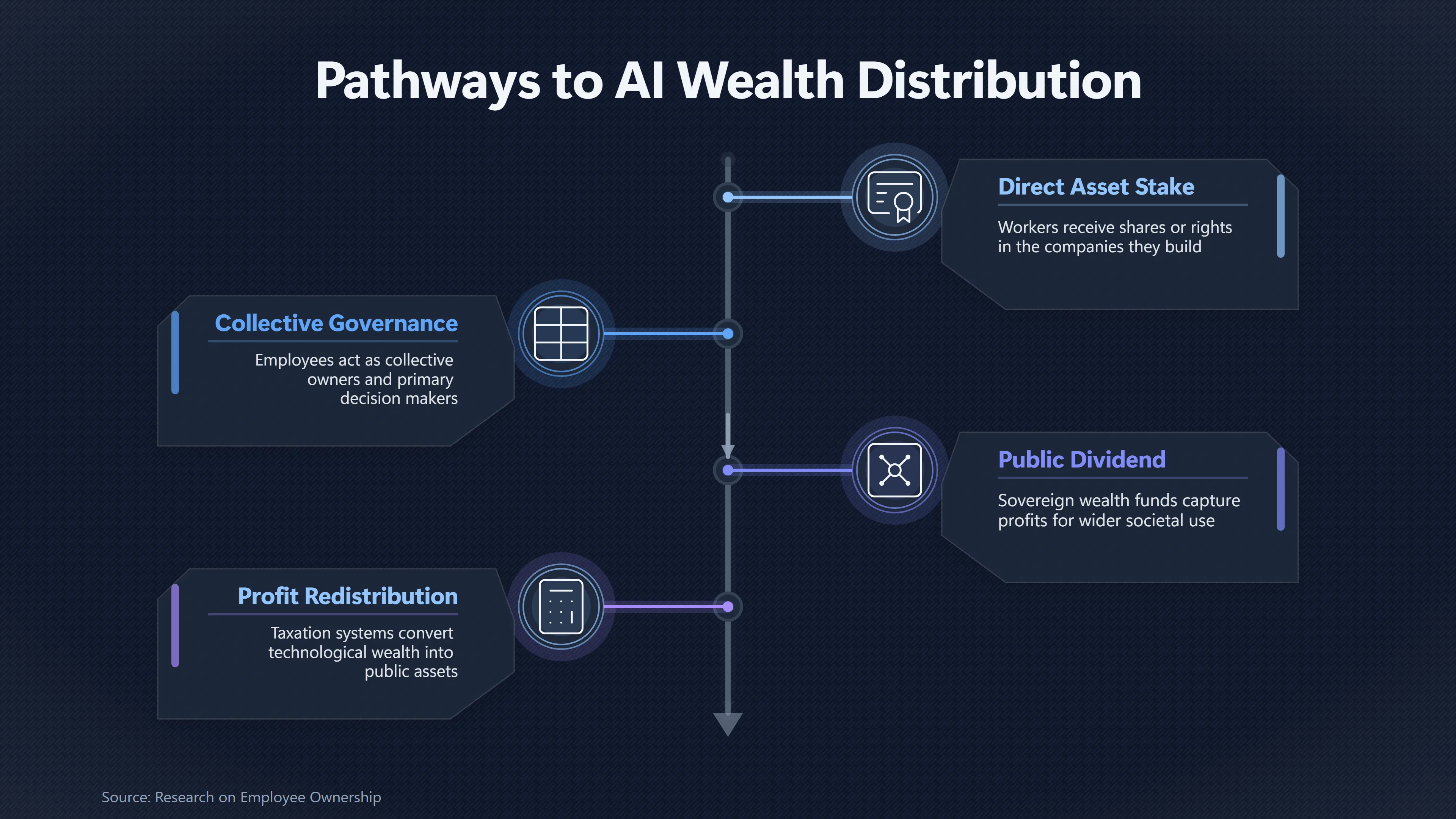
One established route is employee ownership, where workers receive shares or ownership rights in the companies they help build. In the United States, the most common structure is the employee stock ownership plan (ESOP), where company shares are held in a trust for employees. Other models include employee trusts, stock grants, cooperative ownership and profit-sharing arrangements.[nceo.org]nceo.orgNational Center for Employee OwnershipNational Center for Employee Ownership
The attraction of these systems is straightforward: if automation increases company value, workers who remain part of the productive process can benefit from asset appreciation rather than relying only on wages.
Evidence from existing employee-owned firms suggests ownership can improve some worker outcomes. Research reviewed by the National Center for Employee Ownership finds associations between employee ownership and stronger retirement savings, lower employee turnover and improved firm resilience in some contexts. However, researchers also caution that ownership alone is not a guarantee of success; participation, governance structures and company conditions matter.[nceo.org]nceo.orgResearch on Employee OwnershipResearch on Employee Ownership
For AI-driven companies, the challenge is scale. Traditional employee share schemes often work best when a company already has a workforce with a clear relationship to the firm. AI may create highly valuable companies with relatively small numbers of direct employees, making it harder for ordinary workers to gain ownership simply through employment.
Worker cooperatives place ownership and control together
Worker cooperatives go further by making employees the collective owners and decision-makers of a business. The most prominent example is Mondragon Corporation, a network of cooperatives in Spain that has operated across manufacturing, retail, finance and other sectors. Its experience is often cited in debates about whether democratic ownership can coexist with large-scale economic activity.[The New Yorker]newyorker.comThe New Yorker How Mondragon Became the World's Largest Co-OpUnlike conventional companies, Mondragon co-ops operate on principles of democratic governance and profit-sharing among workers, with a m…
Cooperatives appeal to supporters because they combine income sharing with influence over how technology is deployed. In an AI transition, this could mean workers having a say over whether automation is used mainly to reduce headcount, increase profits, improve working conditions, or create new services.
The limitations are also significant. Large-scale AI development requires enormous investment in computing infrastructure, specialised talent and research. Traditional cooperative structures can struggle to raise external capital because investors may be reluctant to provide funding without conventional ownership rights. The question is therefore not whether cooperatives can exist, but where they are most effective within an AI economy.
Public ownership models could capture AI rents for wider society
Another approach moves beyond workplace ownership and argues that AI-generated wealth should partly become a shared public asset.
Some proposals suggest creating AI-focused sovereign wealth funds that hold stakes in major AI companies or capture part of AI-generated profits through taxation. The goal would be to convert concentrated technological wealth into a public dividend, similar in spirit to resource funds that distribute returns from natural resources. Recent political proposals in the United States have brought this idea into wider debate, including proposals for public investment funds linked to AI companies.[AP News]apnews.comThe proposal includes a one-time 50% tax on the stock of AI firms with over $200 million in annual AI revenue, which would raise approxim…
Supporters argue that advanced AI may resemble a general-purpose economic resource whose benefits should not depend entirely on private ownership. Critics respond that government ownership of rapidly changing technology companies could create problems around political interference, investment decisions and competition. Some economists instead favour capturing AI profits through taxation and redistribution while keeping technological development largely competitive.[The Guardian]theguardian.comThe Guardian Bernie Sanders' AI sovereign wealth fund plan is goodBut we think this is betterIn their critique of Bernie Sanders’ AI sovereign wealth fund proposal, Nathan E. Sanders and Bruce Schneier a…
The difficult trade-off: sharing gains without weakening innovation
A central dispute in worker ownership debates is whether broader ownership would slow the very innovation that creates abundance.
AI development is unusually capital-intensive. Training frontier systems requires large computing resources, specialised researchers and substantial financial backing. Policies that reduce incentives for investment could, critics argue, slow scientific progress and delay technologies that could eventually improve health, education and living standards.
Supporters of wider ownership respond that innovation and broad participation do not have to be opposites. Employee ownership research suggests that ownership structures can coexist with productive firms, especially when workers have meaningful participation rather than passive financial claims.[nceo.org]nceo.orgResearch on Employee OwnershipResearch on Employee Ownership
The more difficult question is how to design institutions that preserve incentives while preventing extreme concentration. A small number of companies may be capable of building the most powerful AI systems, but the economic benefits of those systems do not necessarily have to follow the same ownership pattern.
Possible compromises include:
- Broad employee equity: ensuring workers at AI companies receive meaningful ownership rather than only salaries.
- Profit-sharing systems: linking productivity gains to workers without requiring full ownership transfer.
- Public AI dividends: using taxes or public investment returns to distribute some gains across society.
- Worker participation rights: giving employees influence over how automation changes workplaces.
Each model distributes power differently. The key debate is not simply how much wealth AI creates, but who has a voice in deciding how that wealth is used.
What worker ownership could mean for an AI bloom future
The optimistic case for AI is built on the possibility that intelligence becomes dramatically cheaper and more widely available. If AI accelerates science, improves medicine, reduces dangerous work and expands human creativity, the resulting gains could be historically significant.
But abundance does not automatically produce equality or freedom. Previous technological revolutions created enormous wealth while also producing periods of disruption and concentration. The ownership question determines whether AI functions mainly as a force that increases returns to existing capital holders or as a platform for broader participation.
Worker ownership is therefore one possible bridge between automation and shared prosperity. It does not solve every challenge: it cannot replace education, competition policy, democratic institutions or careful AI governance. But it addresses a central economic question of the AI age: whether people should only benefit as consumers of intelligent machines, or whether they should also share in owning the systems that make those machines valuable.
The long-term success of an AI-enabled civilisation may depend not only on creating more intelligence, but on creating institutions capable of turning that intelligence into widely shared human flourishing.
Amazon book picks
Further Reading
Books and field guides related to Can Workers Share AI's New Wealth. Use these as the next step if you want deeper reading beyond the article.
Power and Progress
A bold reinterpretation of economics and history revealing why technology does not inevitably lead to shared prosperity, and how we must...
The Second Machine Age
A New York Times Bestseller. A “fascinating” (Thomas L. Friedman, New York Times) look at how digital technology is transforming our work...
The Age of A. I.
An A.I. that learned to play chess discovered moves that no human champion would have conceived of. Driverlesscars edge forward at red li...
The Technology Trap
A look at the history of technological progress and how it has radically shifted the distribution of economic and political power among s...
eBay marketplace picks
Marketplace Samples
Live-tested eBay searches with available results related to this page.
Selected fromrobot collectible oneBay.co.uk.



Endnotes
1.
Source: nceo.org
Title: Research on Employee Ownership
Link:https://www.nceo.org/research/research-findings-on-employee-ownership
2.
Source: nceo.org
Title: National Center for Employee Ownership
Link:https://www.nceo.org/
3.
Source: nceo.org
Title: Employee Ownership Blog | Nancy Wiefek
Link:https://www.nceo.org/employee-ownership-blog/author/nancy-wiefek
4.
Source: nceo.org
Title: Updated NCEO Paper Compares Employee Ownership Models in Six Countries
Link:https://www.nceo.org/employee-ownership-blog/nceo-paper-compares-employee-ownership-models-in-six-countries
5.
Source: nceo.org
Link:https://www.nceo.org/what-is-employee-ownership
6.
Source: nceo.org
Link:https://www.nceo.org/articles/open-book-management
7.
Source: apnews.com
Link:https://apnews.com/article/57b9f20d96490083e2749adba0f13977
Source snippet
The proposal includes a one-time 50% tax on the stock of AI firms with over $200 million in annual AI revenue, which would raise approxim...
8.
Source: newyorker.com
Title: The New Yorker How Mondragon Became the World’s Largest Co-Op
Link:https://www.newyorker.com/business/currency/how-mondragon-became-the-worlds-largest-co-op
Source snippet
Unlike conventional companies, Mondragon co-ops operate on principles of democratic governance and profit-sharing among workers, with a m...
9.
Source: theguardian.com
Title: The Guardian Bernie Sanders’ AI sovereign wealth fund plan is good
Link:https://www.theguardian.com/commentisfree/2026/jun/08/bernie-sanders-ai-sovereign-wealth-fund-plan
Source snippet
But we think this is betterIn their critique of Bernie Sanders’ AI sovereign wealth fund proposal, Nathan E. Sanders and Bruce Schneier a...
Additional References
10.
Source: laweconcenter.org
Link:https://laweconcenter.org/resources/the-fatal-conceit-gets-a-gpu-cluster-bernie-sanders-plan-to-socialize-ai/
Source snippet
The Fatal Conceit Gets a GPU Cluster: Bernie Sanders’ Plan to Socialize AI - International Center for Law & EconomicsJuly 3, 2026 — The F...
Published: July 3, 2026
11.
Source: law.ucdavis.edu
Title: atlantic quotes professor polcz universal basic capital idea
Link:https://www.law.ucdavis.edu/news/atlantic-quotes-professor-polcz-universal-basic-capital-idea
Source snippet
Atlantic Quotes Professor Polcz on 'Universal Basic Capital' Idea | School of LawJuly 10, 2026 — THE ATLANTIC QUOTES PROFESSOR POLCZ ON '...
Published: July 10, 2026
12.
Source: youtube.com
Title: AI’s Wealth Transfer: Labor vs. Ownership Explained
Link:https://www.youtube.com/watch?v=1JskWvKFv0Q
Source snippet
This video explores how broader models of ownership, employee equity, and public-interest frameworks can ensure that productivity gains f...
13.
Source: youtube.com
Title: The Sovereign Human Initiative: Empowering Workers in the AI Economy
Link:https://www.youtube.com/watch?v=efzcrp9JMuI
Source snippet
The Wealth We Build: Coop 101: Redefining Business Ownership...
14.
Source: youtube.com
Title: The Wealth We Build: Coop 101: Redefining Business Ownership
Link:https://www.youtube.com/watch?v=1i0lWKGtgvo
Source snippet
AI's Wealth Transfer: Labor vs. Ownership Explained...
15.
Source: universalassetowners.com
Title: UAO Editor
Link:https://www.universalassetowners.com/intelligence/the-owners-new-operating-system-2026-07-16/
Source snippet
The Owner's New Operating SystemJuly 16, 2026 — THE OWNER'S NEW OPERATING SYSTEM How AI became the operating layer for the world's larges...
Published: July 16, 2026
16.
Source: sanders.senate.gov
Link:https://www.sanders.senate.gov/press-releases/news-sanders-introduces-legislation-to-create-7-trillion-ai-sovereign-wealth-fund/
17.
Source: iza.org
Link:https://www.iza.org/publications/dp/18196/beliefs-and-the-demand-for-employee-ownership
18.
Source: doi.org
Link:https://doi.org/10.1108/JPEO
19.
Source: emerald.com
Link:https://www.emerald.com/jpeo/article/6/3/194/250778/Employee-ownership-in-the-UK