Within Work at Height
When Safer Construction Robots Create New Hazards
Robots remove fall and collapse hazards only when sites control unexpected movement, blind spots, communication failures and unsafe human proximity.
On this page
- How robotic operating zones can fail
- Why remote cameras reduce operator awareness
- Training, safeguards and human override
Page outline Jump by section
Introduction
Construction robots can remove people from some of the most dangerous jobs at height, but they do not eliminate risk. Instead, they change the types of hazards that construction sites must manage. A worker who no longer climbs onto a fragile roof may instead be working alongside an autonomous vehicle, a remotely operated demolition robot or an inspection drone. The greatest safety challenge therefore shifts from preventing falls alone to preventing unexpected interactions between people and intelligent machines.

This distinction matters for the wider vision of AI-enabled human flourishing. If robotics is to make dangerous work rarer rather than simply different, new technology must be matched by new operating rules, better human-machine communication and safety systems designed for the unpredictable reality of construction sites. Evidence from occupational safety researchers suggests that the biggest remaining problems are not usually failures of robotics themselves, but failures at the boundary where humans and robots share changing workspaces.[cdc.gov]cdc.govconstruction roboticsTransforming Construction: Automation and Robotics for a Safer Future | NIOSH Science Bulletin | CDCNovember 12, 2024…
How robotic operating zones can fail
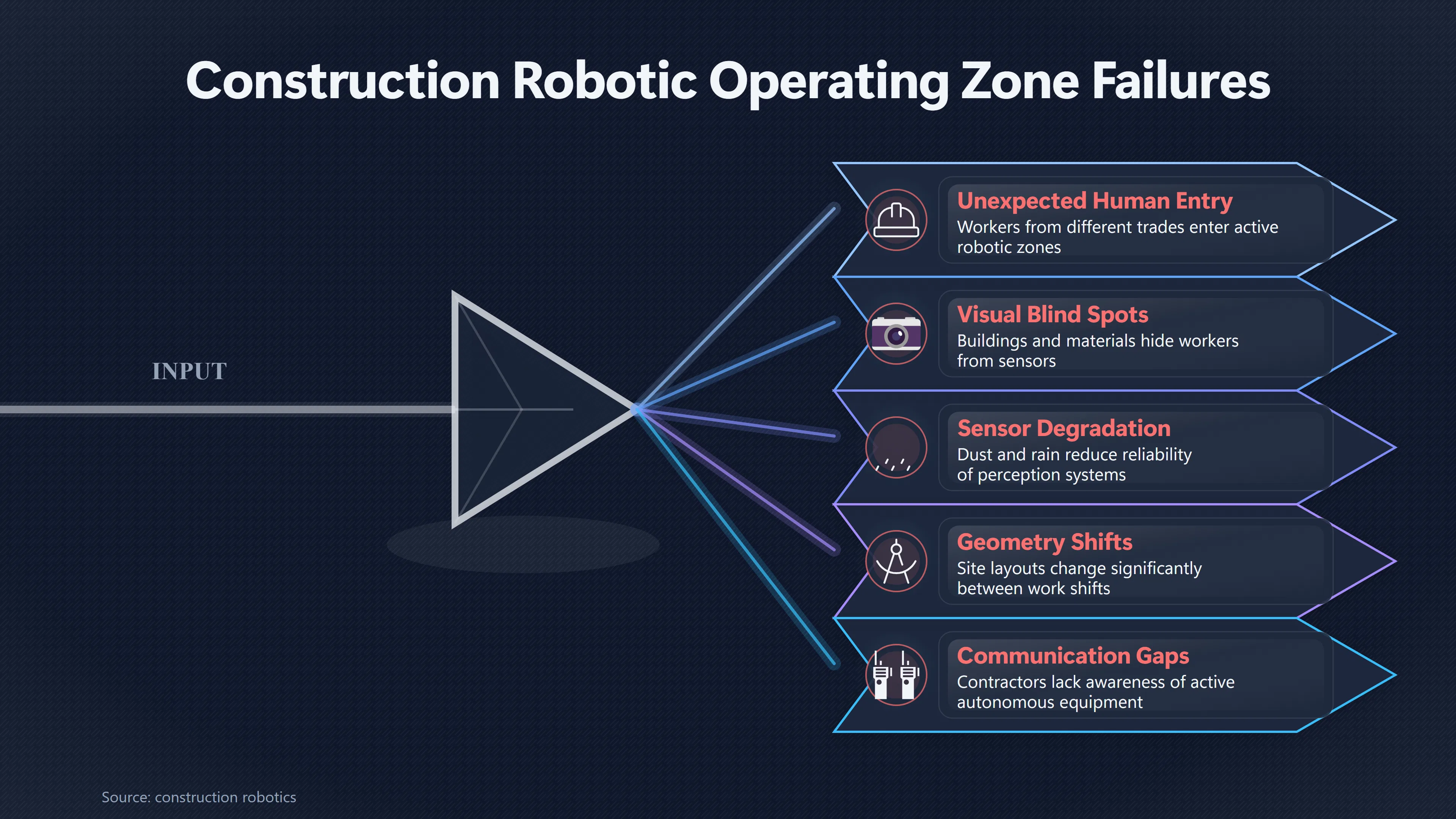
Industrial robots normally work inside fenced-off, carefully controlled environments. Construction sites are almost the opposite. Layouts change daily, multiple contractors share the same space, visibility is often poor, and temporary structures appear and disappear throughout a project.
That makes robotic operating zones much harder to define and enforce. A safe area marked in the morning may become unsafe after materials are delivered, scaffolding is moved or new work begins nearby. Autonomous equipment must also cope with mud, dust, vibration, poor lighting and weather, all of which can affect sensors that detect people or obstacles.[cdc.gov]cdc.govconstruction roboticsTransforming Construction: Automation and Robotics for a Safer Future | NIOSH Science Bulletin | CDCNovember 12, 2024…
Several specific failure modes recur:
- Unexpected human entry. Workers from different trades may unknowingly enter an active robotic work zone.
- Blind spots. Buildings, stored materials and temporary barriers can hide workers from cameras or laser scanners.
- Sensor degradation. Dust, rain or reflective surfaces may reduce the reliability of perception systems.
- Changing site geometry. Robots operating safely on one shift may encounter a substantially altered environment a few hours later.
- Communication failures. Different contractors may not know when autonomous equipment is active or what area it requires.
Unlike traditional machinery, these risks arise because robots make independent movement decisions based on sensor data. If that data becomes incomplete or inaccurate, safe behaviour becomes harder to guarantee.
Why remote cameras reduce operator awareness
Remote operation removes workers from immediate physical danger but can reduce their understanding of what is happening around the machine.
A demolition robot operator may have excellent forward-facing video while lacking awareness of activity behind the robot or around its sides. Camera systems flatten depth perception, restrict peripheral vision and may introduce slight delays. Dust, vibration or poor lighting can further reduce image quality.
Researchers studying remotely operated demolition robots have identified several ways this reduced awareness can create hazards:
- operators unintentionally positioning themselves inside the robot’s danger zone;
- workers approaching the machine from outside the operator’s field of view;
- crushing hazards developing between the robot and walls or structural elements;
- unexpected robot movement creating panic or unsafe reactions nearby.[cdc.gov]cdc.govconstruction roboticsTransforming Construction: Automation and Robotics for a Safer Future | NIOSH Science Bulletin | CDCNovember 12, 2024…
These are not merely theoretical concerns. NIOSH highlights incidents in which workers became trapped between demolition robots and fixed structures despite the machines being designed to improve safety. Such events illustrate that removing the operator from the machine does not automatically remove human exposure to hazardous movement.[cdc.gov]cdc.govconstruction roboticsTransforming Construction: Automation and Robotics for a Safer Future | NIOSH Science Bulletin | CDCNovember 12, 2024…
For work at height, reduced awareness carries an additional consequence. A worker startled by a nearby robot or drone while standing on scaffolding or a roof edge may lose concentration or balance even without direct physical contact. NIOSH is investigating these human-drone interactions using virtual reality to understand whether drone activity can increase the likelihood of acute injury during elevated work.[cdc.gov]cdc.govconstruction roboticsTransforming Construction: Automation and Robotics for a Safer Future | NIOSH Science Bulletin | CDCNovember 12, 2024…
Human-robot collaboration creates different collision risks
Construction robots are increasingly expected to work near people rather than behind permanent barriers. This requires a different approach to safety.
Research presented through NIOSH’s construction robotics programme focuses on limiting the energy transferred if contact occurs, rather than assuming contact can always be prevented. Computer modelling has examined scenarios such as:
- a moving robotic arm striking and pushing a worker;
- a robot causing a person to bend awkwardly after impact;
- mobile equipment pushing workers towards edges or obstacles.
These models recognise that construction workers rarely stand still. They carry materials, climb ladders, move around partially completed structures and often work in confined spaces. Safe collaboration therefore depends on controlling speed, stopping distance and impact forces under changing conditions rather than relying on fixed exclusion zones alone.[cdc.gov]cdc.govconstruction roboticsTransforming Construction: Automation and Robotics for a Safer Future | NIOSH Science Bulletin | CDCNovember 12, 2024…
This is particularly important for work at height. Even relatively low-force contact that would be minor on flat ground could become much more serious if it destabilises someone working near an edge.
Why factory safety standards are not enough
International robot safety standards such as ISO 10218 and ISO/TS 15066 provide important guidance for collaborative robots, including principles such as:
- safety-rated monitored stops;
- speed and separation monitoring;
- power and force limitation;
- direct human guidance where appropriate.[iso.org]iso.orgISO/TS 15066:2016 - Robots and robotic devices — Collaborative robots…
However, these standards were largely developed for industrial environments with predictable layouts and repeatable processes.
Construction presents additional challenges:[cdc.gov]cdc.govSource details in endnotes.
- moving work areas rather than permanent production cells;
- multiple employers sharing one workspace;
- temporary hazards that appear during the working day;
- rapidly changing environmental conditions;
- simultaneous use of cranes, vehicles, drones and manually operated equipment.
As a result, applying factory-based collaborative robotics principles to construction often requires additional site-specific risk assessment rather than simple compliance with existing standards. NIOSH explicitly notes that approaches effective in manufacturing become much harder to implement on dynamic construction projects.[cdc.gov]cdc.govconstruction roboticsTransforming Construction: Automation and Robotics for a Safer Future | NIOSH Science Bulletin | CDCNovember 12, 2024…

Training, safeguards and human override
Successful deployment depends as much on organisational controls as on robot design.
Important safeguards include:
- Clearly defined robotic operating zones that are updated whenever the site layout changes.
- Shared communication protocols so every contractor knows when autonomous equipment is active.
- Layered detection systems, combining cameras, lidar, proximity sensors and emergency stop functions rather than relying on a single sensor.
- Human override capability, allowing operators or nearby workers to stop robotic motion immediately if conditions become unsafe.
- Task-specific training, focusing not only on operating robots but also on recognising robot behaviour, movement patterns and exclusion zones.
- Maintenance procedures that safely isolate robotic systems before inspection or repair.
Older guidance on industrial robotics also remains relevant. Workers should not enter an operating robot’s working envelope unless it has been safely stopped or placed into an appropriate reduced-risk mode, and supervisors should guard against complacency as familiarity with automation grows.[CDC Archive]archive.cdc.govCDC ArchivePreventing the Injury of Workers by Robots (85-103) | NIOSH | CDCDecember 1, 1984…
What this means for AI-enabled construction
Construction robotics supports the broader AI abundance vision because it offers a credible path towards reducing some of the most dangerous forms of manual labour, especially work at height, demolition and hazardous inspection. Yet the technology succeeds only if it shifts workers away from danger rather than introducing new unmanaged risks.
The central lesson from current evidence is that safer robots do not create automatically safer construction sites. Instead, they require sites to evolve from protecting workers against static machinery to managing continuous interaction between people and intelligent, mobile systems. The most successful deployments are therefore likely to combine increasingly capable AI with conservative safety engineering, strong human oversight and worksite procedures that assume unexpected events will occur rather than assuming autonomous systems will always behave perfectly.[cdc.gov]cdc.govconstruction roboticsTransforming Construction: Automation and Robotics for a Safer Future | NIOSH Science Bulletin | CDCNovember 12, 2024…
Amazon book picks
Further Reading
Books and field guides related to When Safer Construction Robots Create New Hazards. Use these as the next step if you want deeper reading beyond the article.
The Design of Everyday Things
Even the smartest among us can feel inept as we fail to figure out which light switch or oven burner to turn on, or whether to push, pull...
Robot Ethics: The Ethical and Social Implications of Robotics
Prominent experts from science and the humanities explore issues in robot ethics that range from sex to war. Robots today serve in many r...
Safety-I and Safety-II: The Past and Future of Safety Management
Safety has traditionally been defined as a condition where the number of adverse outcomes was as low as possible (Safety-I). From a Safet...
Human Error
James Reason has produced a major theoretical integration of several previously isolated literatures in his new book Human Error. Much of...
eBay marketplace picks
Marketplace Samples
Live-tested eBay searches with available results related to this page.
Selected fromdrone model oneBay.co.uk.
Current eBay listing
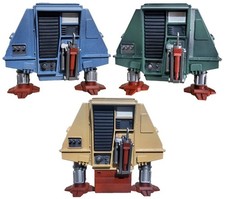
Silent Running Drone Robot Dewey Huey Louie Model Kits Sci-Fi


Current eBay listing
DJI Drone/ Or model Vinyl WP HQ Decals, Free PnP Easy To Apply
Endnotes
1.
Source: cdc.gov
Title: construction robotics
Link:https://www.cdc.gov/niosh/blogs/2024/construction-robotics.html
Source snippet
Transforming Construction: Automation and Robotics for a Safer Future | NIOSH Science Bulletin | CDCNovember 12, 2024...
Published: November 12, 2024
2.
Source: cdc.gov
Link:https://www.cdc.gov/niosh/blogs/2021/future-of-construction.html
3.
Source: iso.org
Link:https://www.iso.org/standard/62996.html
Source snippet
ISO/TS 15066:2016 - Robots and robotic devices — Collaborative robots...
4.
Source: iso.org
Link:https://www.iso.org/news/2016/03/Ref2057.html
Source snippet
Robots and humans can work together with new ISO guidance...
5.
Source: archive.cdc.gov
Link:https://archive.cdc.gov/www_cdc_gov/niosh/docs/85-103/default.html
Source snippet
CDC ArchivePreventing the Injury of Workers by Robots (85-103) | NIOSH | CDCDecember 1, 1984...
Published: December 1, 1984
6.
Source: archive.cdc.gov
Link:https://archive.cdc.gov/www_cdc_gov/niosh/enews/enewsv21n10.html
Source snippet
cdc.goveNews: Volume 21, Number 10 (February 2024) | NIOSH | CDCFebruary 2, 2024 — ENEWS: VOLUME 21, NUMBER 10 (FEBRUARY 2024) Print Down...
Published: February 2, 2024
7.
Source: stacks.cdc.gov
Link:https://stacks.cdc.gov/view/cdc/145622
8.
Source: archive.cdc.gov
Title: robotics workplace safety
Link:https://archive.cdc.gov/www_cdc_gov/niosh/newsroom/feature/robotics-workplace-safety.html
9.
Source: cdc.gov
Title: wearable construction
Link:https://www.cdc.gov/niosh/bulletin/2019/wearable-construction.html
10.
Source: cdc.gov
Link:https://www.cdc.gov/niosh/bulletin/2017/drones.html
11.
Source: iso.org
Link:https://www.iso.org/fr/standard/62996.html
12.
Source: iso.org
Link:https://www.iso.org/cms/%20render/live/en/sites/isoorg/contents/data/standard/06/29/62996.html
13.
Source: iso.org
Link:https://www.iso.org/cms/%20render/live/es/sites/isoorg/contents/data/standard/06/29/62996.html
14.
Source: iso.org
Link:https://www.iso.org/es/contents/data/standard/06/29/62996.html
15.
Source: osha.gov
Link:https://www.osha.gov/robotics/standards
Source snippet
Robotics - Standards | Occupational Safety and [Health]({{ 'health/' | relative_url }}) Administration...
16.
Source: osha.gov
Link:https://www.osha.gov/robotics/hazards
Additional References
17.
Source: frontiersin.org
Title: Frontiers | Robotics and automation safety risks in construction
Link:https://www.frontiersin.org/journals/built-environment/articles/10.3389/fbuil.2025.1653188/full
Source snippet
Built Environ., 09 February 2026 Sec. Construction Management Volume 11 - 2025 | [https://doi.org/10.3389/fbuil.2025.1653188](https://doi.org/10.3389/fbuil.2025.1653188) Published in...
Published: February 2026
18.
Source: osha.gov
Title: Guidelines For Robotics Safety | Occupational Safety and Health Administration
Link:https://www.osha.gov/enforcement/directives/std
Source snippet
Guidelines For Robotics Safety | Occupational Safety and Health Administration...
19.
Source: youtube.com
Title: Heavy Equipment Safety Toolbox Talk (Hazards)
Link:https://www.youtube.com/watch?v=5fjKdL5IdF0
Source snippet
Powered Mobile Equipment Safety | ACSA Training | CSTS Clip...
20.
Source: sciencedirect.com
Link:https://www.sciencedirect.com/science/article/pii/S0926580510000361
21.
Source: youtube.com
Title: How to ensure a robot is safe
Link:https://www.youtube.com/watch?v=7BeXbJscCAg
Source snippet
Heavy Equipment Safety Toolbox Talk (Hazards)...
22.
Source: osha.gov
Title: OSH A Technical Manual (OTM)
Link:https://www.osha.gov/otm/section-4-safety-hazards/chapter-4
23.
Source: youtube.com
Title: Powered Mobile Equipment Safety | ACSA Training | CSTS Clip
Link:https://www.youtube.com/watch?v=nc0ZIdMMi4o
24.
Source: youtube.com
Title: You Think Robots Are Safe Think Again
Link:https://www.youtube.com/watch?v=sWKRbrYXQmU
Source snippet
Robotics Safety in the Workplace...
25.
Source: youtube.com
Title: Robotics Safety in the Workplace
Link:https://www.youtube.com/watch?v=zWffSfZdnx8
Source snippet
How to ensure a robot is safe...
26.
Source: automate.org
Title: iso ts 15066 explained
Link:https://www.automate.org/robotics/tech-papers/iso-ts-15066-explained