Within AI Abundance
Can Cheap AI Tutoring Produce Real Learning?
AI can make personalised explanations plentiful, but real learning still depends on engagement, assessment, motivation and human support.
On this page
- Why responsive instruction can scale cheaply
- What current studies say about learning outcomes
- Why motivation, assessment and teachers still matter
Page outline Jump by section
Introduction
If advanced AI makes high-quality explanations almost free, will education become abundant in the same way that digital information did? The answer is more complicated than it first appears. AI tutoring can dramatically reduce the cost of delivering personalised instruction, giving many more people access to explanations, examples, feedback and practice than was previously affordable. That is a genuine step towards making intelligence more widely available.
However, cheap instruction is not the same as cheap learning. Learning is not simply receiving information. It depends on attention, effort, memory, motivation, practice, assessment, social support and opportunities to apply knowledge. Current evidence increasingly suggests that AI can improve learning under the right conditions, especially when designed around educational principles and combined with teachers or structured study. But simply giving every student access to a chatbot does not guarantee understanding, and may even create an illusion of mastery if learners outsource too much thinking. This distinction matters for any vision of AI-enabled abundance: society may achieve abundant tutoring long before it achieves abundant learning.
Why responsive instruction can scale cheaply
For most of history, personalised teaching has been scarce because it depended on scarce human expertise. A good tutor can ask questions, identify misconceptions, adapt explanations and encourage persistence, but every hour spent with one student is an hour unavailable to another.
Large language models change that economic equation.
Instead of producing one explanation for an entire class, an AI system can generate different explanations for millions of learners simultaneously. A student struggling with algebra can receive simpler examples. Another can request visual analogies. Someone learning in a second language can receive translations or slower explanations without imposing additional costs on a teacher.
The marginal cost of another conversation becomes extremely low compared with hiring another tutor. If the underlying model already exists, serving an additional learner mainly requires computing resources rather than years of professional training.
This makes personalised instruction resemble a digital good. Just as search engines made information retrieval dramatically cheaper, AI may make adaptive explanation, questioning and guided practice available at a scale that was previously impossible.
Within the broader idea of AI abundance, this is one of the clearest examples of intelligence becoming less scarce. The constraint shifts away from generating explanations and towards helping people actually learn from them.
The promise and limits of the “two sigma” dream
Educational researchers have long recognised the remarkable effectiveness of one-to-one tutoring.
Benjamin Bloom’s famous “two sigma” finding suggested that individually tutored students often outperformed conventionally taught students by around two standard deviations—roughly moving an average student towards the top of the class. The challenge was never proving that personalised teaching worked. It was making it affordable enough to provide at scale.
AI appears to offer a possible answer to that long-standing economic problem.
Unlike earlier educational software built around fixed decision trees, modern language models can conduct open-ended dialogue, respond to unusual questions and adapt explanations dynamically. They can encourage students to explain their reasoning instead of simply revealing answers, making them much closer to conversational tutors than previous generations of educational technology. Emerging research has therefore focused less on whether AI can converse, and more on whether those conversations produce durable learning rather than temporary task completion.[OECD]oecd-ilibrary.org062a7394 enOECDOECD Digital Education Outlook 2026 (EN)January 12, 2026…
The distinction is crucial. Producing the right answer during a conversation is not necessarily evidence that the student has acquired knowledge they can use later without AI assistance.
What current studies say about learning outcomes
The evidence has become considerably stronger over the past few years, but it remains mixed because different systems are used in different ways.
Several recent randomised controlled trials have found encouraging results when AI tutors are carefully designed around learning science rather than general conversation.
Research on GPT-4-supported interactive homework found improvements in both student engagement and measured learning compared with traditional homework, partly because the system continually asked follow-up questions instead of simply providing solutions.[arXiv]arxiv.orgGPT-4 as a Homework Tutor can Improve Student Engagement and Learning OutcomesSeptember 24, 2024…
Other studies reviewed by the OECD similarly conclude that educational AI systems designed with explicit pedagogical goals can improve learning, critical thinking and collaboration, particularly when they encourage dialogue, questioning and formative feedback rather than answer generation.[oecd.org]oecd.orgoecd digital education outlook 2026 062a7394 enOECD Digital Education Outlook 2026 | OECD…
An especially interesting pattern concerns human tutors rather than students. In a large randomised trial discussed by the OECD, AI coaching helped inexperienced tutors adopt better questioning and scaffolding strategies, substantially narrowing the gap between novice and expert tutors. Instead of replacing teachers, AI helped spread expert teaching practices more widely.[OECD]oecd-ilibrary.org062a7394 enOECDOECD Digital Education Outlook 2026 (EN)January 12, 2026…
These findings support an important idea within the broader AI bloom discussion: intelligence can become abundant not only by replacing experts but by amplifying many more people’s ability to teach effectively.
Why better performance is not always better learning
The most important caution emerging from current research is that completing tasks successfully is not the same as learning.
Students with unrestricted access to general-purpose chatbots often produce higher-quality assignments than students working alone. But when those same students later complete assessments without AI assistance, the apparent advantage frequently shrinks or disappears. In some studies it reverses entirely.[oecd.org]oecd.orgoecd digital education outlook 2026 062a7394 enOECD Digital Education Outlook 2026 | OECD…
This happens because AI can substitute for cognitive effort.
Learning requires building durable mental models through retrieval, problem-solving and productive struggle. If AI performs too much of that work, students may experience what educational researchers sometimes describe as an illusion of competence: work appears easier and answers appear correct, but the underlying knowledge has not been encoded strongly enough for independent use.
The OECD therefore distinguishes between:
- Performance support, where AI helps complete today’s task.
- Learning support, where AI improves what the student can do tomorrow without assistance.
That distinction is becoming one of the central questions in AI education research.[oecd.org]oecd.orgoecd digital education outlook 2026 062a7394 enOECD Digital Education Outlook 2026 | OECD…
Why motivation, assessment and teachers still matter
Making explanations abundant does not remove many of education’s hardest problems.
A learner still has to decide to begin studying, persist through frustration and return repeatedly over weeks or months. AI can encourage these behaviours, but it cannot guarantee them.
Several human factors remain difficult to automate.
Motivation. Students who lack confidence, interest or long-term goals often require encouragement, accountability and relationships that extend beyond answering questions.
Assessment. Teachers determine not only whether answers are correct but whether understanding transfers into unfamiliar situations. Good assessment increasingly requires evaluating reasoning, judgement and application rather than polished outputs that AI can generate.
Classroom management. Schools provide routines, expectations and social environments that shape learning in ways conversational software does not replace.
Pastoral support. Teachers recognise emotional difficulties, family circumstances and social challenges that influence educational success.
Current educational guidance increasingly frames AI as an augmentation technology rather than a replacement for teachers. Human educators become designers of learning experiences, interpreters of assessment and providers of motivation, while AI supplies inexpensive personalised practice and feedback.[oecd.org]oecd.orgoecd digital education outlook 2026 062a7394 enOECD Digital Education Outlook 2026 | OECD…
The importance of pedagogical design
The strongest evidence does not support the idea that any chatbot naturally becomes a good tutor.
Instead, outcomes depend heavily on design choices.
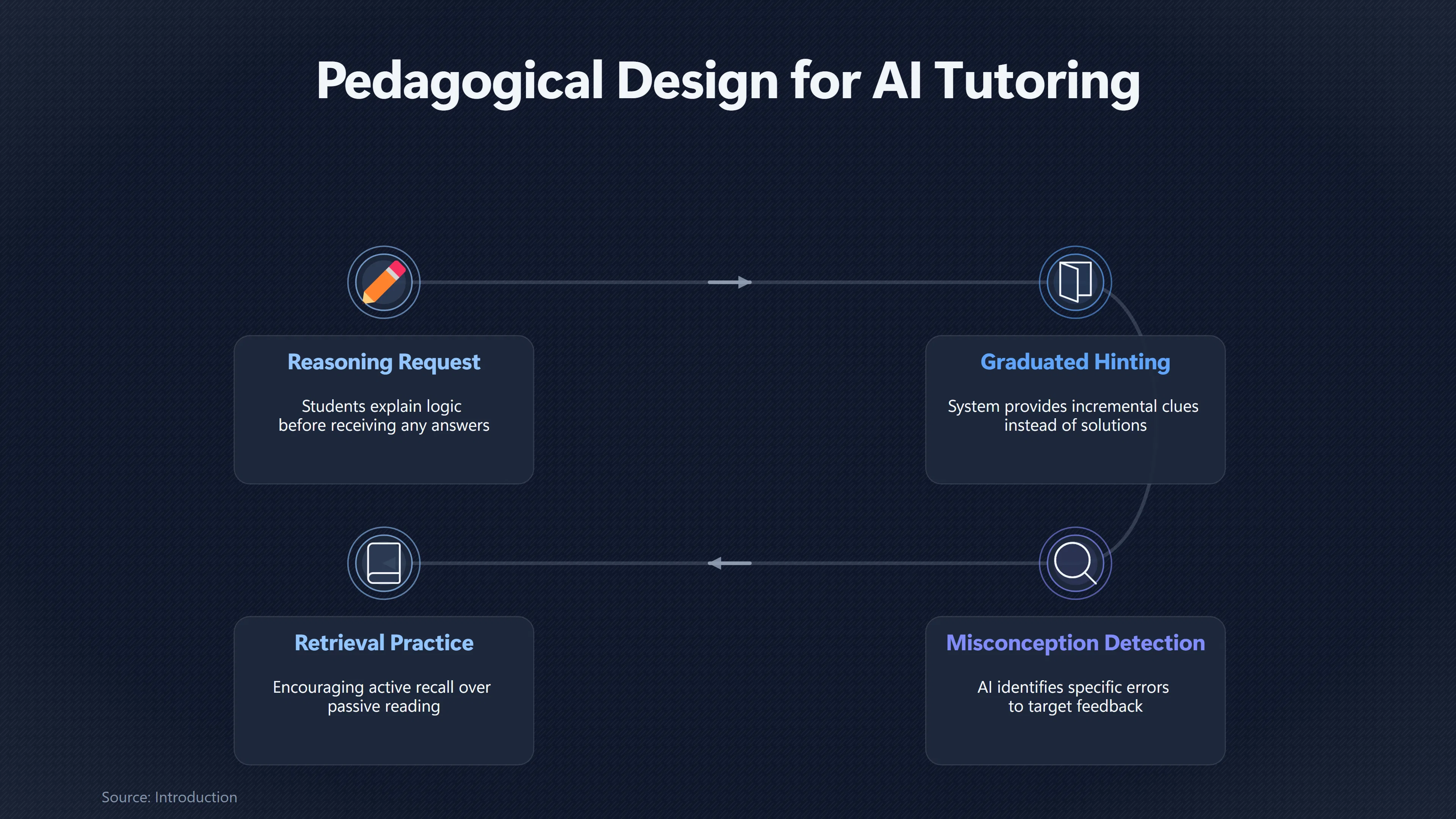
Successful educational systems increasingly use techniques such as:
- Asking students to explain their reasoning before revealing answers.
- Providing graduated hints rather than complete solutions.
- Detecting misconceptions and targeting feedback accordingly.
- Encouraging retrieval practice instead of passive reading.
- Prompting reflection after solving problems.
- Adjusting difficulty as competence improves.
These strategies come from decades of cognitive science rather than from language models themselves. AI becomes valuable because it can deliver them consistently at enormous scale.
General-purpose chatbots can often imitate these behaviours, but systems explicitly engineered around learning objectives tend to produce more reliable educational outcomes.[oecd.org]oecd.orgoecd digital education outlook 2026 062a7394 enOECD Digital Education Outlook 2026 | OECD…
Equal instruction does not mean equal opportunity to learn
Even if AI tutoring became universally available, educational inequality would not disappear automatically.
Students differ in internet access, device quality, study environments, parental support, prior knowledge and available time. A personalised tutor cannot create a quiet home, reduce financial stress or compensate fully for years of accumulated disadvantage.
The same technology may therefore produce unequal benefits.
Highly motivated learners often exploit AI to deepen understanding, explore new topics and practise independently. Students already struggling with organisation or foundational skills may instead rely on AI for shortcuts that reduce genuine learning.
The optimistic vision of abundant intelligence therefore depends not only on software but also on broader educational institutions. Access to effective teachers, well-designed assessments, reliable digital infrastructure and supportive learning environments all influence whether AI narrows or widens educational inequalities.[oecd.org]oecd.orgoecd digital education outlook 2026 062a7394 enOECD Digital Education Outlook 2026 | OECD…
What this means for an AI-enabled future
Within the larger question of whether AI could help humanity flourish on an unprecedented scale, education provides an instructive example of both the promise and the limits of technological abundance.
The optimistic case is strong. If billions of people can obtain personalised explanations, instant feedback and adaptive practice at minimal cost, humanity’s total stock of accessible knowledge could expand dramatically. Lifelong learning, career retraining and global access to expertise become much more realistic.
Yet education also reminds us that scarcity does not disappear simply because information becomes cheap.
Attention remains scarce. Motivation remains scarce. Trustworthy assessment remains scarce. Supportive relationships remain scarce.
The likely future is therefore one in which instruction becomes increasingly abundant while learning itself continues to depend on human effort, effective institutions and careful educational design. AI may remove one of education’s largest historical bottlenecks—the scarcity of personalised explanation—but the deeper work of transforming explanations into lasting understanding will continue to require learners, teachers and communities working together.
Amazon book picks
Further Reading
Books and field guides related to Can Cheap AI Tutoring Produce Real Learning?. Use these as the next step if you want deeper reading beyond the article.
Make It Stick
To most of us, learning something "the hard way" implies wasted time and effort. Good teaching, we believe, should be creatively tailored...
How Learning Works
Praise for How Learning Works "How Learning Works is the perfect title for this excellent book. Drawing upon new research in psychology,...
Why Don't Students Like School?
Research-based insights and practical advice about effective learning strategies In this new edition of the highly regarded Why Don't Stu...

The End of Average
First published 2016. Subjects: Individuality, MATHEMATICS / Probability & Statistics / General, PSYCHOLOGY / Applied Psychology, Average...
eBay marketplace picks
Marketplace Samples
Live-tested eBay searches with available results related to this page.
Selected fromeducation robot toy oneBay.co.uk.
Endnotes
1.
Source: oecd.org
Title: oecd digital education outlook 2026 062a7394 en
Link:https://www.oecd.org/en/publications/oecd-digital-education-outlook-2026_062a7394-en.html
Source snippet
OECD Digital Education Outlook 2026 | OECD...
2.
Source: arxiv.org
Link:https://arxiv.org/abs/2409.15981
Source snippet
GPT-4 as a Homework Tutor can Improve Student Engagement and Learning OutcomesSeptember 24, 2024...
Published: September 24, 2024
3.
Source: oecd.org
Title: How to effectively use Generative AI in education
Link:https://www.oecd.org/en/blogs/2026/01/how-to-effectively-use-generative-ai-in-education.html
4.
Source: oecd.org
Title: 062a7394 en
Link:https://www.oecd.org/content/dam/oecd/en/publications/reports/2026/01/oecd-digital-education-outlook-2026_940e0dd8/062a7394-en.pdf
5.
Source: oecd.org
Title: The Power of Feedback | OECD
Link:https://www.oecd.org/en/about/projects/the-power-of-feedback.html
6.
Source: oecd.org
Link:https://www.oecd.org/en/publications/reimagining-teaching-in-an-accelerating-world_d0edfe8c-en/full-report/component-6.html
7.
Source: oecd.org
Title: component 7
Link:https://www.oecd.org/en/publications/education-policy-outlook-2024_dd5140e4-en/full-report/component-7.html
8.
Source: oecd.org
Link:https://www.oecd.org/en/topics/sub-issues/artificial-intelligence-and-education-and-skills.html
9.
Source: oecd-ilibrary.org
Title: 062a7394 en
Link:https://www.oecd-ilibrary.org/content/dam/oecd/en/publications/reports/2026/01/oecd-digital-education-outlook-2026_940e0dd8/062a7394-en.pdf
Source snippet
OECDOECD Digital Education Outlook 2026 (EN)January 12, 2026...
Published: January 12, 2026
10.
Source: oecd-ilibrary.org
Title: teaching for today s world eefb146b
Link:https://www.oecd-ilibrary.org/en/publications/results-from-talis-2024_90df6235-en/full-report/teaching-for-today-s-world_eefb146b.html
Additional References
11.
Source: wired.com
Link:https://www.wired.com/story/what-aspects-of-teaching-should-remain-human
Source snippet
Developed by Satya Nitta, Origin integrates AI to help with summoning educational resources and answering student queries quickly and acc...
12.
Source: pmc.ncbi.nlm.nih.gov
Link:https://pmc.ncbi.nlm.nih.gov/articles/PMC13274167/
Source snippet
impact of integrating generative artificial intelligence into medical education on short-term learning outcomes: a systematic review and...
13.
Source: nature.com
Link:https://www.nature.com/articles/s41598-025-97652-6
14.
Source: nature.com
Link:https://www.nature.com/articles/s41599-026-07019-z
15.
Source: nature.com
Link:https://www.nature.com/articles/s41599-026-06903-y
16.
Source: youtube.com
Title: How AI tutors and teaching assistants will transform education
Link:https://www.youtube.com/watch?v=qlh8fiLiovI
Source snippet
Good Will Tutoring: Why the Best AI Behaves Like a Great Human Tutor...
17.
Source: youtube.com
Title: Good Will Tutoring: Why the Best AI Behaves Like a Great Human Tutor
Link:https://www.youtube.com/watch?v=wLr6svaDyjU
Source snippet
AI, Learning & the Human Mind: Why Effort Still Matters...
18.
Source: link.springer.com
Link:https://link.springer.com/article/10.1007/s44217-026-01872-5
Source snippet
of AI-based tutoring and assessment systems in mathematics education: a systematic review | Discover Education | Springer Nature LinkJuly...
19.
Source: link.springer.com
Link:https://link.springer.com/article/10.1186/s40862-026-00421-9
Source snippet
of Artificial intelligence tools on learning motivation in English instruction: a network meta-analysis | Asian-Pacific Journal of Second...
20.
Source: youtube.com
Title: How AI Could Save (Not Destroy) Education | Sal Khan | TED
Link:https://www.youtube.com/watch?v=hJP5GqnTrNo
Source snippet
How AI tutors and teaching assistants will transform education...