Within Income Security
Can services replace lost job security?
Universal basic services aim to protect living standards by guaranteeing essentials such as healthcare, education, housing support and transport when incomes
On this page
- How essential services reduce financial pressure
- Which needs public systems can cover
- Trade offs between security and personal choice
Page outline Jump by section
Introduction
Universal basic services (UBS) are a way of protecting living standards by guaranteeing access to essential goods and services rather than relying only on wages or cash payments. In an economy shaped by advanced AI and automation, the idea matters because even a society that becomes much richer could still leave people insecure if housing, healthcare, education, transport and other necessities remain expensive or difficult to access. UBS aims to create a stable foundation: people would have the essentials needed to participate in society even if employment becomes less predictable.[ucl.ac.uk]ucl.ac.ukUniversal Basic Services | UCL Bartlett Faculty of the Built EnvironmentJanuary 23, 2022…
The strongest case for UBS in an AI-enabled future is not that it replaces all income or solves every economic problem. Rather, it changes the relationship between people and essential costs. If AI increases productivity and lowers the cost of producing many goods and services, universal access systems could help ensure that those gains translate into everyday security instead of simply higher returns for those who own the technology. But the model also raises difficult questions: which services should be guaranteed, how much choice individuals should retain, how systems should be funded, and how governments can avoid creating slow or unresponsive public monopolies.
How essential services reduce financial pressure
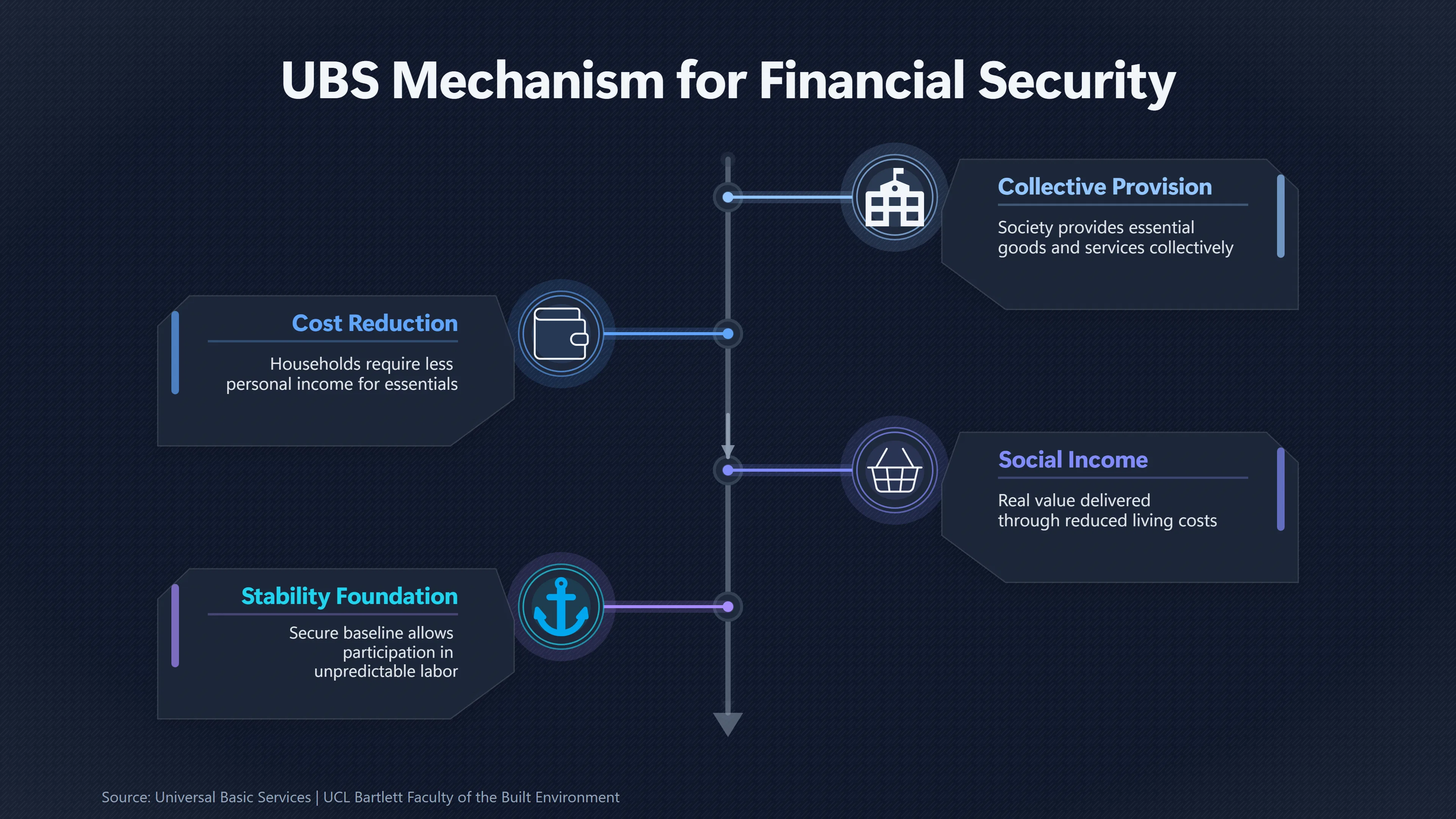
The central mechanism behind universal basic services is simple: households need less income to achieve a secure standard of living when some essential needs are provided collectively.
A person who receives healthcare, education, affordable housing support, childcare, transport access or digital connectivity through public systems does not need to purchase all of these separately from their wages. This can act as a form of “social income” — not money paid directly into an account, but real value delivered through reduced costs and greater security. The UCL Institute for Global Prosperity describes UBS as services provided free at the point of need that expand people’s opportunities, participation and capabilities.[ucl.ac.uk]ucl.ac.ukUniversal Basic Services | UCL Bartlett Faculty of the Built EnvironmentJanuary 23, 2022…
This becomes especially relevant if employment patterns change. AI may not immediately eliminate most jobs, and current evidence suggests automation is developing unevenly across occupations. However, even without mass unemployment, workers may face more frequent transitions between jobs, training, caring responsibilities and different forms of employment. A system that guarantees essential services reduces the risk that every transition becomes a personal financial crisis.[oecd.org]oecd.orgA I and the Future of Social Protection | OECDA I and the Future of Social Protection | OECD
The practical effect is different from a traditional wage-based model:
- Healthcare security means illness is less likely to become a financial disaster.
- Affordable education and training make career changes easier when technology changes demand for skills.
- Housing support reduces exposure to one of the largest household expenses.
- Transport and digital access help people reach jobs, education and public services.
- Care services reduce the burden on families when childcare or eldercare needs rise.
Universal healthcare provides a clear example of the mechanism. The World Health Organization defines universal health coverage as ensuring people can access needed health services without financial hardship. Yet global evidence shows why financial protection matters: millions of people still experience serious economic strain from paying directly for healthcare.[World Health Organization]who.intWorld Health Organization Universal health coverage (UHCWorld Health OrganizationUniversal health coverage (UHC)December 5, 2025…
In an AI bloom scenario, the argument for UBS becomes broader. If technology eventually creates far greater abundance, the question shifts from “can society produce enough?” to “can people reliably access what society can produce?” UBS is one possible institutional answer to that second question.
Which needs public systems can cover
Universal basic services do not usually mean that every possible good becomes free. The focus is on foundational services that strongly affect human capability and participation.
Health and care
Healthcare is often considered the clearest example because access affects both human wellbeing and economic security. A person who can receive treatment early is more able to work, learn, care for others and participate socially. Without protection from large medical costs, even high-income societies can leave people vulnerable to sudden shocks.[World Health Organization]who.intWorld Health Organization Financial protectionWorld Health Organization Financial protection
Future AI advances could make this area even more important. AI-assisted diagnosis, drug discovery and personalised medicine could expand healthcare capability, but the benefits depend on whether access is broadly distributed. A future where AI accelerates medical breakthroughs but only wealthy groups can afford advanced care would fall short of the wider human flourishing goals associated with AI abundance.
Education and lifelong learning
In an economy where AI changes tasks quickly, education becomes less like a one-time investment and more like a lifelong public capability.
Universal access to high-quality learning could help people use AI tools effectively, move into new fields and develop uniquely human abilities such as judgement, creativity and collaboration. Public education systems already provide much of this foundation, but an AI-driven economy may increase demand for continuous retraining and personalised learning support.
Housing and basic living conditions
Housing is one of the most difficult areas for UBS because governments have less direct control over supply, land prices and construction costs. However, housing support, social housing and planning reforms can reduce the share of income required simply to remain secure.
This matters because a society can experience technological abundance while households remain under pressure from fixed costs. Lower costs for information, software or manufactured goods do not automatically solve expensive housing markets.
Transport and digital access
Transport and internet access are increasingly viewed as enabling services because they determine whether people can participate in modern economic and social life.
A person without reliable connectivity may struggle to access education, healthcare appointments, government services or AI-enabled tools. As more public services become digital, access to technology itself becomes part of social infrastructure rather than merely a consumer choice.
Why services may matter in an AI-rich economy
Universal basic income (UBI) and universal basic services are often compared because both attempt to provide security when employment becomes less central. They solve different problems.
UBI provides flexibility: people receive money and decide how to spend it. UBS provides guaranteed access: society ensures that certain needs are met regardless of individual purchasing power.
The distinction matters because some needs cannot be solved easily through cash alone. If housing supply is limited, additional income can increase competition for homes rather than guarantee affordability. If healthcare prices rise faster than incomes, cash payments may not provide the same security as a functioning public health system.
Supporters of UBS argue that shared systems can also create efficiency by pooling resources. The economist Ian Gough has argued that UBS is based on the idea that some human needs are best met through collective systems rather than individual purchasing decisions.[eprints.lse.ac.uk]eprints.lse.ac.ukUniversal Basic Services: a theoretical and moral frameworkLSE Research Online…
However, UBS is not automatically superior. Cash provides personal choice, and public systems can become bureaucratic or inflexible. A future society may need a combination: universal services for essential foundations, income support for personal freedom, and labour-market policies that help people adapt to technological change.
The trade-off between security and personal choice
The biggest debate around universal basic services is where to draw the boundary between collective provision and individual choice.
A strong UBS system can provide stability. People may be more willing to change careers, start businesses, care for relatives or pursue education if losing a job does not threaten access to essentials. In this sense, security can increase freedom rather than reduce it.
But critics raise several concerns.
- Choice: A public service may not meet everyone’s preferences. Some people may prefer private alternatives or different models of provision.
- Cost: High-quality universal services require sustainable taxation and effective administration.
- Capacity: Governments must ensure that services expand when demand grows.
- Innovation: Poorly designed systems could become resistant to improvement.
The challenge is therefore not simply whether services should exist, but how they should be designed. A successful UBS model would need accountability, user choice where possible, transparent performance standards and continuous improvement.
AI itself could affect this debate. The OECD notes that AI has potential to improve social protection systems by making services easier to access, identifying needs earlier and reducing administrative burdens, while also warning about risks such as poor decisions and loss of human oversight.[oecd.org]oecd.orgA I and the Future of Social Protection | OECDA I and the Future of Social Protection | OECD
What universal services would need to achieve for AI bloom
For the optimistic AI future to become a shared human future, abundance must translate into capability. People need more than access to cheap products; they need the foundations that allow them to learn, create, stay healthy and participate.
Universal basic services represent one possible bridge between technological progress and everyday security. They do not guarantee equality, and they cannot replace good governance, democratic accountability or fair distribution of AI-generated wealth. But they address a central problem: even a highly productive civilisation can fail to deliver human flourishing if essential needs remain insecure.
The long-term question for an AI-enabled society is therefore not only how much intelligence machines create, but how intelligently societies organise access to the benefits that intelligence makes possible. UBS is one mechanism for ensuring that greater technological capability becomes a wider expansion of human opportunity rather than simply a larger economy with the same vulnerabilities.
Amazon book picks
Further Reading
Books and field guides related to Can services replace lost job security?. Use these as the next step if you want deeper reading beyond the article.
The Spirit Level
Everyone knows that the poor in rich societies are more likely to have shorter, less healthy, lives, to do less well at school and to end...
The Body Economic
Politicians have talked endlessly about the seismic economic and social impacts of the recent financial crisis, but many continue to igno...
eBay marketplace picks
Marketplace Samples
Live-tested eBay searches with available results related to this page.
Selected fromtechnology home decor oneBay.co.uk.


Endnotes
1.
Source: ucl.ac.uk
Title: Universal Basic Services | UCL Bartlett Faculty of the Built Environment
Link:https://www.ucl.ac.uk/bartlett/research-projects/2022/jan/universal-basic-services
Source snippet
January 23, 2022...
Published: January 23, 2022
2.
Source: eprints.lse.ac.uk
Title: Universal Basic Services: a theoretical and moral framework
Link:https://eprints.lse.ac.uk/101051/
Source snippet
LSE Research Online...
3.
Source: oecd.org
Title: A I and the Future of Social Protection | OECD
Link:https://www.oecd.org/en/about/projects/ai-and-the-future-of-social-protection.html
4.
Source: who.int
Title: World Health Organization Universal health coverage (UHC)
Link:https://www.who.int/news-room/fact-sheets/detail/universal-health-coverage-%28uhc%29
Source snippet
World Health OrganizationUniversal health coverage (UHC)December 5, 2025...
Published: December 5, 2025
5.
Source: who.int
Title: World Health Organization Financial protection
Link:https://www.who.int/health-topics/financial-protection
6.
Source: oecd.org
Title: harnessing artificial intelligence in social security b52405c1 en
Link:https://www.oecd.org/en/publications/harnessing-artificial-intelligence-in-social-security_b52405c1-en.html
7.
Source: oecd.org
Link:https://www.oecd.org/en/publications/harnessing-artificial-intelligence-in-social-security_b52405c1-en/full-report/executive-summary_8bc468ed.html
8.
Source: oecd.org
Title: effective use of ai in social security e639350c
Link:https://www.oecd.org/en/publications/harnessing-artificial-intelligence-in-social-security_b52405c1-en/full-report/effective-use-of-ai-in-social-security_e639350c.html
9.
Source: oecd.org
Title: full report
Link:https://www.oecd.org/en/publications/harnessing-artificial-intelligence-in-social-security_b52405c1-en/full-report.html
10.
Source: oecd.org
Title: ai and the future of social protection in oecd countries 7b245f7e en
Link:https://www.oecd.org/en/publications/ai-and-the-future-of-social-protection-in-oecd-countries_7b245f7e-en.html
11.
Source: oecd.ai
Title: A I and the future of social protection in OECD countries
Link:https://oecd.ai/en/ai-publications/ai-and-the-future-of-social-protection-in-oecd-countries
12.
Source: pmnch.who.int
Title: int New WHO report reveals governments deprioritizing health spending
Link:https://pmnch.who.int/news-and-events/news/item/12-12-2024-new-who-report-reveals-governments-deprioritizing-health-spending
13.
Source: wkc.who.int
Title: int New publication sheds light on tracking inequalities in financial hardship
Link:https://wkc.who.int/resources/news/item/09-08-2024-new-publication-sheds-light-on-tracking-inequalities-in-financial-hardship
14.
Source: partnership.who.int
Link:https://partnership.who.int/iomc/publications/i/item/tracking-inequalities-in-financial-hardship-due-to-out-of-pocket-health-spending-by-age-structure-of-a-household-technical-brief-on-measurement
15.
Source: oecd.org
Title: component 4
Link:https://www.oecd.org/en/publications/modernising-access-to-social-protection_af31746d-en/full-report/component-4.html
16.
Source: extranet.who.int
Title: int Billions left behind on the path to universal health coverage
Link:https://extranet.who.int/uhcpartnership/news/billions-left-behind-path-universal-health-coverage
17.
Source: ucl.ac.uk
Link:https://www.ucl.ac.uk/bartlett/research-projects/2022/mar/research-project-i-social-prosperity-network
18.
Source: ucl.ac.uk
Title: social prosperity future proposal universal basic services 2017
Link:https://www.ucl.ac.uk/bartlett/publications/2022/feb/social-prosperity-future-proposal-universal-basic-services-2017
19.
Source: who.int
Link:https://www.who.int/europe/publications/i/item/9789289054058
20.
Source: ucl.ac.uk
Link:https://www.ucl.ac.uk/bartlett/news/2017/oct/igps-social-prosperity-network-publishes-uks-first-report-universal-basic-services
21.
Source: who.int
Link:https://www.who.int/publications/i/item/WHO-HSE-WSH-12.01/
22.
Source: ucl.ac.uk
Link:https://www.ucl.ac.uk/bartlett/ideas/bartlett-review/bartlett-review-2017/future-welfare-universal-basic-services
23.
Source: who.int
Title: financial protection
Link:https://www.who.int/data/gho/data/themes/topics/financial-protection
24.
Source: who.int
Title: financial hardship and components of population globally global
Link:https://www.who.int/data/gho/data/indicators/indicator-details/GHO/financial-hardship-and-components—-of-population-globally—global-%28-%29
25.
Source: who.int
Title: financial hardship in health and components sdg 3.8.2 2025 definition
Link:https://www.who.int/data/gho/data/themes/topics/topic-details/GHO/financial-hardship-in-health-and-components-sdg-3.8.2-2025-definition
26.
Source: who.int
Link:https://www.who.int/data/gho/data/indicators/indicator-details/GHO/financial-hardship-and-components—millions-of-people–globally–global-%28millions%29
27.
Source: who.int
Link:https://www.who.int/activities/monitoring-financial-protection
28.
Source: oecd.org
Link:https://www.oecd.org/en/topics/future-of-social-protection.html
29.
Source: [discovery]({{ ‘discovery/’ | relative_url }}). ucl.ac.uk
Link:https://discovery.ucl.ac.uk/id/eprint/10080175/
30.
Source: discovery.ucl.ac.uk
Title: ucl.ac.uk Universal Basic Services: Theory and Practice
Link:https://discovery.ucl.ac.uk/id/eprint/10080177/
31.
Source: neweconomics.org
Link:https://neweconomics.org/campaigns/universal-basic-services
Additional References
32.
Source: theguardian.com
Link:https://www.theguardian.com/technology/2026/jul/25/ai-jobs-apocalypse-human-labor
Source snippet
In March 2026, AI company Anthropic reported no significant rise in unemployment among workers most exposed to AI since late 2022, with A...
Published: March 2026
33.
Source: GOV.UK
Link:https://www.gov.uk/government/publications/our-children-our-future-tackling-child-poverty-monitoring-and-evaluation-baseline-report/our-children-our-future-tackling-child-poverty-monitoring-and-evaluation-baseline-report
Source snippet
Children, Our Future: Tackling Child Poverty: Monitoring and Evaluation - Baseline Report - GOV.UKJuly 9, 2026 — Recognising the importan...
Published: July 9, 2026
34.
Source: england.shelter.org.uk
Title: HELP WITH RENT Universal credit (UC) has a housing element to help wi
Link:https://england.shelter.org.uk/housing_advice/benefits/extra_financial_help_if_you_claim_universal_credit
Source snippet
help if you get universal credit - Shelter EnglandJune 25, 2026 — EXTRA HELP IF YOU GET UNIVERSAL CREDIT You could get extra help with co...
Published: June 25, 2026
35.
Source: youtube.com
Title: Will AI Take My Job? The Future of Work Explained
Link:https://www.youtube.com/watch?v=9Ny4eYi3gUk
Source snippet
This selection offers essential insights into The case for Universal Basic Services, explaining how public provisioning of life's essenti...
36.
Source: youtube.com
Title: Geoff Crocker
Link:https://www.youtube.com/watch?v=Elucfd4wkgc
Source snippet
Will AI Take My Job? The Future of Work Explained...
37.
Source: youtube.com
Link:https://www.youtube.com/watch?v=GKNgFVxF28M
Source snippet
Universal Basic Services (UBS) Roundtable - UK Week...
38.
Source: youtube.com
Title: The case for Universal Basic Services
Link:https://www.youtube.com/watch?v=eYmNia4giH8
Source snippet
Universal Basic Income and Universal Basic Services: Complementary or Competitive?...
39.
Source: youtube.com
Title: Universal Basic Services (UBS) Roundtable
Link:https://www.youtube.com/watch?v=gGJ8kR0pSzU
Source snippet
Geoff Crocker - Rethinking Income and Money: Incorporating Technology Into Economic Theory...
40.
Source: prosperity2030.uk
Link:https://prosperity2030.uk/
Source snippet
Prosperity 2030 · UCL Institute for Global ProsperityJuly 14, 2026 — Prosperity 2030 Home → Press → In the news → Contact → Read the repo...
Published: July 14, 2026
41.
Source: cambridge.org
Link:https://www.cambridge.org/core/journals/perspectives-on-politics/article/ai-the-future-of-work-and-the-politics-of-the-welfare-state/92E806B812B86A8944003B77038DCAA8