Within AI Principles
Can Global AI Rules Reflect Many Cultures?
Global AI ethics frameworks show how societies can seek shared protections while accepting that values and interpretations differ across cultures.
On this page
- The search for shared AI principles
- Why different societies interpret values differently
- Building inclusive governance for powerful AI
Page outline Jump by section
Introduction
UNESCO’s AI ethics framework is one of the most ambitious attempts to create a shared global foundation for governing artificial intelligence. Adopted by UNESCO’s 193 Member States in 2021, the Recommendation on the Ethics of Artificial Intelligence does not attempt to impose a single cultural vision of how societies should use AI. Instead, it tries to establish common protections — such as human dignity, human rights, fairness, transparency, sustainability and human oversight — while allowing countries to interpret and implement them through their own legal and social systems.[UNESCO]unesco.orgEthics of Artificial IntelligenceEthics of Artificial Intelligence - AI | UNESCO…
This balance is central to the wider question of whether advanced AI can contribute to human flourishing. If AI eventually accelerates scientific discovery, improves health, expands education and helps reduce scarcity, the benefits will depend partly on whether societies trust the systems shaping that future. UNESCO’s approach argues that legitimacy cannot come only from technical capability; it must also come from participation, accountability and recognition of cultural diversity.[UNESCO]unesco.orgRecommendation on the Ethics of Artificial IntelligenceRecommendation on the Ethics of Artificial Intelligence - Legal Affairs…
The challenge is that AI ethics involves values where societies often agree at a high level but disagree in practice. Protecting privacy, preventing discrimination and preserving human agency sound universal, but different communities may weigh these goals differently. UNESCO’s framework is therefore less a final global constitution for AI than an attempt to create a shared language for negotiating difficult choices.
The search for shared AI principles
The need for global AI principles comes from a basic problem: AI systems increasingly affect decisions that cross national borders. A medical AI model developed in one country may influence healthcare elsewhere. A language model trained on global information may shape education, communication and public debate worldwide. A future generation of highly capable AI systems could influence scientific research, economic opportunity and political decision-making at a scale far beyond previous technologies.
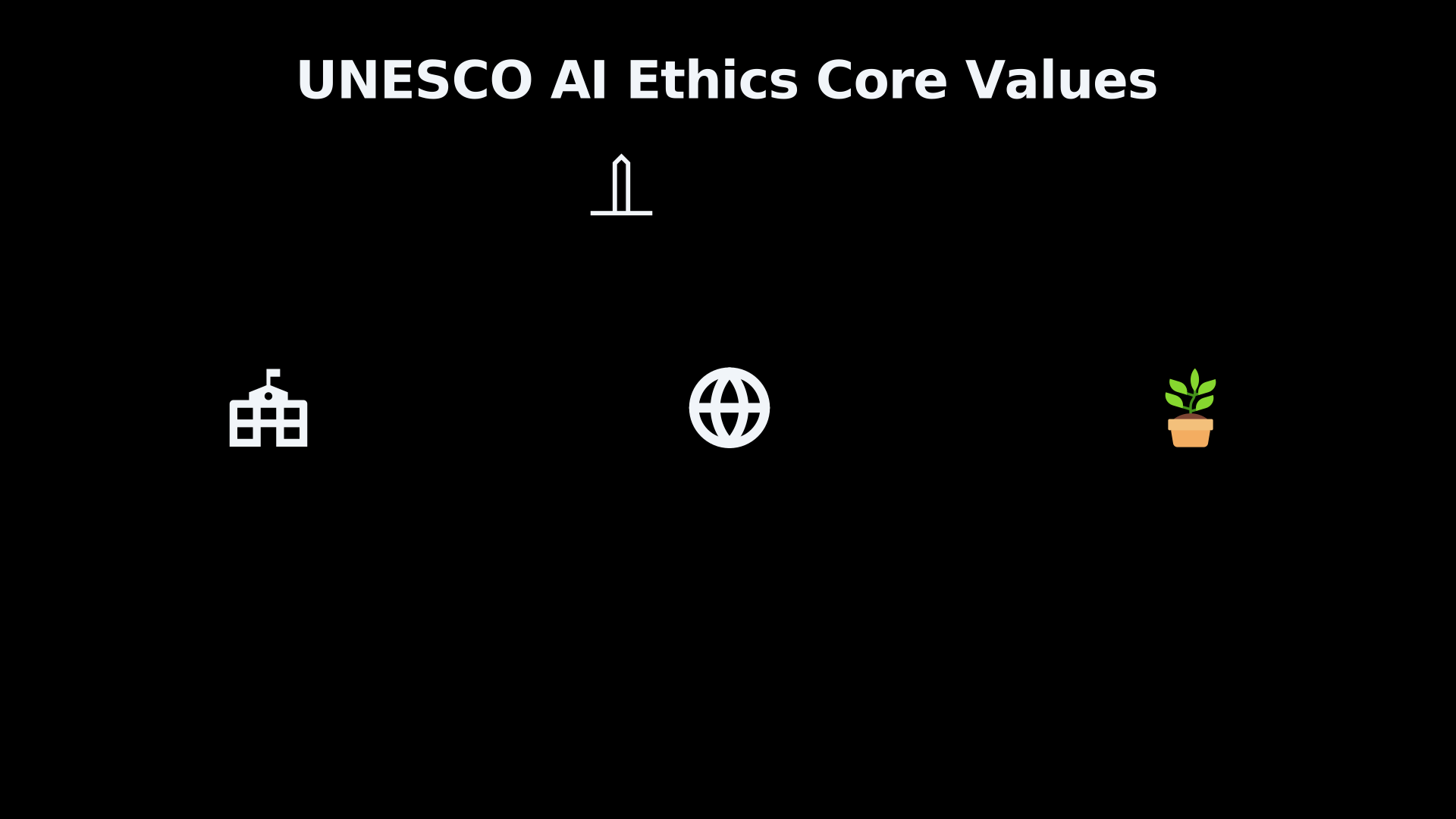
UNESCO’s framework responds by placing AI within an international human rights tradition rather than treating it only as a technical innovation. Its central idea is that AI should support human development while protecting people from harms such as discrimination, loss of privacy, environmental damage and exclusion. The Recommendation identifies four broad values: respect for human dignity and rights, the creation of fair and peaceful societies, diversity and inclusion, and environmental protection.[UNESCO]unesco.orgEthics of Artificial IntelligenceEthics of Artificial Intelligence - AI | UNESCO…
The framework also moves beyond general statements by outlining practical areas for action. These include data governance, environmental impacts, education, gender equality, health, research, communication and information access. This matters because a principle such as “fairness” only becomes meaningful when institutions decide how to measure unfair outcomes, who should be protected and what remedies should exist when AI systems cause harm.[UNESCO]unesco.orgrecommendation ethics artificial intelligenceRecommendation on the Ethics of Artificial Intelligence | UNESCOMay 16, 2023…
For the AI bloom vision — where AI could help humanity achieve greater abundance, scientific progress and long-term flourishing — this principle-based approach addresses a crucial question: how can powerful intelligence remain connected to human goals rather than simply maximising narrow measures of efficiency or economic value? UNESCO’s answer is that human rights and public participation must remain the foundation.
Why different societies interpret AI values differently
A global AI framework faces a difficult reality: shared values do not always produce identical policies.
Many societies support ideas such as dignity, safety and equal opportunity. However, disagreements emerge when values compete. A government may prioritise stronger protections against misinformation, while another may place greater emphasis on freedom of expression. Some societies may favour extensive data sharing to accelerate medical research, while others may give stronger priority to privacy. Different cultures may also have different understandings of community responsibility, individual autonomy and the role of government.
UNESCO explicitly recognises this tension. Its Recommendation notes that AI development can challenge cultural diversity and local ethical standards, while also arguing that governance should respect diversity and encourage global intercultural dialogue. It calls for inclusive participation across different communities, languages, backgrounds and social groups.[UNESCO]unesco.orgRecommendation on the Ethics of Artificial IntelligenceRecommendation on the Ethics of Artificial Intelligence - Legal Affairs…
This makes UNESCO’s legitimacy strategy different from a simple attempt to find one universal moral formula. Instead, it seeks agreement on processes as much as outcomes. A legitimate AI governance system should allow affected groups to participate, make decisions explainable, provide ways to challenge harmful outcomes and ensure that less powerful communities are not merely recipients of rules created elsewhere.
This is especially important because AI capabilities are unevenly distributed. Advanced AI development is concentrated among a relatively small number of companies and countries, creating a risk that the future direction of the technology could reflect the priorities of those with the greatest resources rather than the preferences of humanity as a whole. International governance efforts increasingly focus on reducing this imbalance through cooperation and capacity building.[Reuters]reuters.comun advisory body makes seven recommendations governing aiCreated last year, this 39-member advisory body aims to provide impartial and reliable scientific knowledge about AI, addressing informat…
Building inclusive governance for powerful AI
UNESCO’s framework is influential because it treats legitimacy as something that must be built continuously, not granted once. The Recommendation encourages governments to involve researchers, companies, civil society groups and affected communities in AI governance. It also recommends monitoring, evaluation and accountability mechanisms rather than relying only on voluntary ethical promises.[UNESCO]unesco.orgRecommendation on the Ethics of Artificial IntelligenceRecommendation on the Ethics of Artificial Intelligence - Legal Affairs…

From principles to real-world institutions
The gap between agreeing on principles and applying them is one of the biggest challenges in global AI ethics.
A statement that AI should be “fair” does not automatically answer practical questions:
- Which groups should be assessed for unequal impacts?
- How should competing interests be balanced?
- Who audits powerful AI systems?
- What happens when a company or government causes harm?
- How can smaller countries participate meaningfully?
UNESCO has developed tools intended to help countries move from principles to implementation. Its Readiness Assessment Methodology is designed to help governments evaluate their preparedness and identify areas where further support is needed.[UNESCO]unesco.orgEthics of Artificial IntelligenceEthics of Artificial Intelligence - AI | UNESCO…
However, implementation remains uneven. Research tracking responsible AI governance has found that many countries have created AI policies or initiatives, but translating commitments into enforceable protections, institutional capacity and effective redress remains difficult.[arXiv]arxiv.orgGlobal Index on Responsible AI: 2026 ReportJuly 16, 2026…
This distinction matters for the future of advanced AI. A world where AI dramatically improves medicine, science or education would require more than shared aspirations. It would require institutions capable of ensuring that benefits are broadly accessible and that powerful systems remain accountable.
Why cultural inclusion affects the AI bloom question
The optimistic case for AI is not only about making existing systems faster or cheaper. It is about expanding what humanity can achieve: faster scientific discovery, better health outcomes, greater access to knowledge and new possibilities for creativity. But a future shaped by AI will reflect the values built into its institutions and technologies.
If only a narrow group defines the goals of advanced AI, the result may be a future that is technically impressive but socially limited. A truly human-centred AI bloom would require many cultures and communities to have a role in deciding what progress means.
UNESCO’s approach therefore addresses a deeper governance problem: intelligence alone does not tell civilisation what to value. More powerful AI increases the importance of collective judgement about fairness, dignity, freedom, responsibility and the kind of future humanity wants to create.
The limits of global AI ethics agreements
UNESCO’s framework provides a shared foundation, but it does not solve every governance problem.
The Recommendation is a voluntary international standard rather than a binding global law. UNESCO encourages member states to apply its principles and adapt them within their own legal systems, but enforcement depends largely on national governments and other institutions.[UNESCO]unesco.orgRecommendation on the Ethics of Artificial IntelligenceRecommendation on the Ethics of Artificial Intelligence - Legal Affairs…
This creates both a strength and a weakness. A voluntary framework can achieve broader agreement because countries with different political systems and cultural traditions can accept common principles without surrendering full control over implementation. But the same flexibility can make it difficult to ensure consistent protection across borders.
There is also a deeper philosophical challenge. Even a widely accepted framework cannot remove all value conflicts. Questions about acceptable risk, the distribution of AI-generated wealth, the role of human labour and the limits of machine autonomy will remain contested as AI becomes more capable.
For this reason, global legitimacy may depend less on discovering a perfect list of principles and more on creating trustworthy processes for revising them. Powerful AI systems may change society in ways that cannot be predicted today, making adaptability an essential part of governance.
UNESCO’s contribution is therefore not that it provides a final answer to AI ethics. Its importance lies in establishing a global starting point: the idea that the benefits of increasingly powerful AI should be pursued alongside human rights, cultural diversity, environmental responsibility and meaningful participation.
For an AI-enabled human bloom, this is a central condition. A future of abundance and expanded human capability will require not only better machines, but better collective decisions about how those machines serve humanity.
Amazon book picks
Further Reading
Books and field guides related to Can Global AI Rules Reflect Many Cultures?. Use these as the next step if you want deeper reading beyond the article.
Human Compatible
A leading artificial intelligence researcher lays out a new approach to AI that will enable us to coexist successfully with increasingly...
The Alignment Problem
Finalist for the Los Angeles Times Book Prize A jaw-dropping exploration of everything that goes wrong when we build AI systems and the m...
The Age of A. I.
An A.I. that learned to play chess discovered moves that no human champion would have conceived of. Driverlesscars edge forward at red li...
AI Superpowers
THE NEW YORK TIMES, USA TODAY, AND WALL STREET JOURNAL BESTSELLER "Kai-Fu Lee believes China will be the next tech-innovation superpower...
eBay marketplace picks
Marketplace Samples
Live-tested eBay searches with available results related to this page.
Selected fromai technology poster oneBay.co.uk.



Endnotes
1.
Source: unesco.org
Title: Ethics of Artificial Intelligence
Link:https://www.unesco.org/en/artificial-intelligence/recommendation-ethics?hub=70235
Source snippet
Ethics of Artificial Intelligence - AI | UNESCO...
2.
Source: unesco.org
Title: Recommendation on the Ethics of Artificial Intelligence
Link:https://www.unesco.org/en/legal-affairs/recommendation-ethics-artificial-intelligence?hub=1063
Source snippet
Recommendation on the Ethics of Artificial Intelligence - Legal Affairs...
3.
Source: unesco.org
Title: recommendation ethics artificial intelligence
Link:https://www.unesco.org/en/articles/recommendation-ethics-artificial-intelligence?hub=66973
Source snippet
Recommendation on the Ethics of Artificial Intelligence | UNESCOMay 16, 2023...
Published: May 16, 2023
4.
Source: reuters.com
Title: un advisory body makes seven recommendations governing ai 2024 09 19
Link:https://www.reuters.com/technology/artificial-intelligence/un-advisory-body-makes-seven-recommendations-governing-ai-2024-09-19/
Source snippet
Created last year, this 39-member advisory body aims to provide impartial and reliable scientific knowledge about AI, addressing informat...
5.
Source: unesco.org
Title: Ethics of Artificial Intelligence
Link:https://www.unesco.org/en/artificial-intelligence/recommendation-ethics?hub=918
Source snippet
Ethics of Artificial Intelligence - AI | UNESCO...
6.
Source: arxiv.org
Link:https://arxiv.org/abs/2607.14782
Source snippet
Global Index on Responsible AI: 2026 ReportJuly 16, 2026...
Published: July 16, 2026
7.
Source: core.unesco.org
Link:https://core.unesco.org/en/project/3210454021
Source snippet
unesco.orgProject: Supporting the implementation of UNESCO's Recommendation on AI Ethics details | Core Data PortalJanuary 1, 2024 — [BUT...
Published: January 1, 2024
8.
Source: core.unesco.org
Link:https://core.unesco.org/en/project/3210453011
9.
Source: unesdoc.unesco.org
Title: document Viewer.xhtml
Link:https://unesdoc.unesco.org/in/documentViewer.xhtml?ark=%2Fark%3A%2F48223%2Fpf0000381137%2FPDF%2F381137eng.pdf.multi&file=%2Fin%2Frest%2FannotationSVC%2FDownloadWatermarkedAttachment%2Fattach_import_75c9fb6b-92a6-4982-b772-79f540c9fc39%3F_%3D381137eng.pdf&fullScreen=true&id=p%3A%3Ausmarcdef_0000381137&locale=en&updateUrl=updateUrl6452&v=2.1.196
10.
Source: unesdoc.unesco.org
Title: document Viewer.xhtml
Link:https://unesdoc.unesco.org/in/documentViewer.xhtml?ark=%2Fark%3A%2F48223%2Fpf0000381137%2FPDF%2F381137eng.pdf.multi&file=%2Fin%2Frest%2FannotationSVC%2FDownloadWatermarkedAttachment%2Fattach_import_e86c4b5d-5af9-4e15-be60-82f1a09956fd%3F_%3D381137eng.pdf&fullScreen=true&id=p%3A%3Ausmarcdef_0000381137&locale=en&updateUrl=updateUrl6756&v=2.1.196
11.
Source: unesdoc.unesco.org
Title: document Viewer.xhtml
Link:https://unesdoc.unesco.org/in/documentViewer.xhtml?ark=%2Fark%3A%2F48223%2Fpf0000381137%2FPDF%2F381137eng.pdf.multi&file=%2Fin%2Frest%2FannotationSVC%2FDownloadWatermarkedAttachment%2Fattach_import_e86c4b5d-5af9-4e15-be60-82f1a09956fd%3F_%3D381137eng.pdf&fullScreen=true&id=p%3A%3Ausmarcdef_0000381137&locale=fr&updateUrl=updateUrl2468&v=2.1.196
12.
Source: unesdoc.unesco.org
Title: document Viewer.xhtml
Link:https://unesdoc.unesco.org/in/documentViewer.xhtml?ark=%2Fark%3A%2F48223%2Fpf0000381137por%2FPDF%2F381137por.pdf&file=%2Fin%2Frest%2FannotationSVC%2FDownloadWatermarkedAttachment%2Fattach_import_9946263c-f568-4674-8cd0-154ab58eba98%3F%3D381137por.pdf&id=p%3A%3Ausmarcdef_0000381137_por&locale=en&multi=true&v=2.1.196
13.
Source: unesdoc.unesco.org
Title: document Viewer.xhtml
Link:https://unesdoc.unesco.org/in/documentViewer.xhtml?ark=%2Fark%3A%2F48223%2Fpf0000381137fre%2FPDF%2F381137fre.pdf&file=%2Fin%2Frest%2FannotationSVC%2FDownloadWatermarkedAttachment%2Fattach_import_aa43725b-27ae-48a2-be12-dfdd8f0194a7%3F%3D381137fre.pdf&id=p%3A%3Ausmarcdef_0000381137_fre&locale=en&multi=true&v=2.1.196
14.
Source: unesdoc.unesco.org
Title: document Viewer.xhtml
Link:https://unesdoc.unesco.org/in/documentViewer.xhtml?ark=%2Fark%3A%2F48223%2Fpf0000377897%2FPDF%2F377897eng.pdf&file=%2Fin%2Frest%2FannotationSVC%2FDownloadWatermarkedAttachment%2Fattach_import_4bc33956-d665-48ad-92af-57ae532c98ef%3F_%3D377897eng.pdf&id=p%3A%3Ausmarcdef_0000377897&locale=es&multi=true&v=2.1.196
15.
Source: courier.unesco.org
Title: working not against humanity
Link:https://courier.unesco.org/en/articles/working-not-against-humanity
16.
Source: unesco.org
Title: Ethics of Artificial Intelligence
Link:https://www.unesco.org/en/artificial-intelligence/recommendation-ethics?hub=66489
17.
Source: unesco.org
Title: Ethics of Artificial Intelligence
Link:https://www.unesco.org/en/artificial-intelligence/recommendation-ethics?hub=32618
18.
Source: core.unesco.org
Link:https://core.unesco.org/en/project/537GLO3001
19.
Source: unesco.org
Title: Ethics of Artificial Intelligence
Link:https://www.unesco.org/en/artificial-intelligence/recommendation-ethics?hub=66909
20.
Source: core.unesco.org
Link:https://core.unesco.org/en/project/549GLO3003
21.
Source: unesco.org
Link:https://www.unesco.org/ethics-ai/en?hub=195885
22.
Source: unesco.org
Title: Ethics of Artificial Intelligence
Link:https://www.unesco.org/en/artificial-intelligence/recommendation-ethics?hub=953
23.
Source: core.unesco.org
Link:https://core.unesco.org/en/project/570GLO3027
24.
Source: unesco.org
Link:https://www.unesco.org/ethics-ai/en/global-hub
25.
Source: unesco.org
Link:https://www.unesco.org/ethics-ai/ar
26.
Source: unesco.org
Title: Ethics of Artificial Intelligence
Link:https://www.unesco.org/en/artificial-intelligence/recommendation-ethics?hub=66778
27.
Source: unesco.org
Title: Ethics of Artificial Intelligence
Link:https://www.unesco.org/en/artificial-intelligence/recommendation-ethics?hub=158596
28.
Source: iicba.unesco.org
Title: botswana artificial intelligence readiness assessment report
Link:https://www.iicba.unesco.org/es/africa-education-knowledge-platform/botswana-artificial-intelligence-readiness-assessment-report
29.
Source: unesco.de
Title: Artificial Intelligence
Link:https://www.unesco.de/en/topics/science/ethics-emerging-technologies/ai/
30.
Source: unesco.de
Title: Ethical AI worldwide
Link:https://www.unesco.de/en/topics/science/ethics-emerging-technologies/ai/ethical-ai-worldwide/
31.
Source: unesco.de
Title: UNESC O-Empfehlung zur Ethik der Künstlichen Intelligenz
Link:https://www.unesco.de/dokumente-und-hintergruende/publikationen/detail/unesco-empfehlung-zur-ethik-der-kuenstlichen-intelligenz/
32.
Source: montrealethics.ai
Title: UNESC O’s Recommendation on the Ethics of AI | Montreal AI Ethics Institute
Link:https://montrealethics.ai/unescos-recommendation-on-the-ethics-of-ai/
33.
Source: gp-digital.org
Link:https://www.gp-digital.org/unescos-draft-recommendation-on-ethics-and-ai-our-thoughts-on-the-final-text/
34.
Source: gcedclearinghouse.org
Link:https://gcedclearinghouse.org/en/node/129375?level=7
35.
Source: unece.org
Link:https://unece.org/documents/2021/09/informal-documents/unesco-draft-text-recommendation-ethics-artificial
36.
Source: unsceb.org
Title: Artificial Intelligence | United Nations
Link:https://unsceb.org/topics/artificial-intelligence
37.
Source: unesco.org.nz
Link:https://unesco.org.nz/knowledge-hub/ethics-of-artificial-intelligence-recommendation
Additional References
38.
Source: ungm.org
Title: Artificial Intelligence Readiness Assessment Methodology (RAM)
Link:https://www.ungm.org/Public/Notice/290738
Source snippet
February 9, 2026 — ARTIFICIAL INTELLIGENCE READINESS ASSESSMENT METHODOLOGY (RAM) UNESCO Artificial Intelligence Readiness Assessment Met...
Published: February 9, 2026
39.
Source: youtube.com
Link:https://www.youtube.com/watch?v=6AF3hKwWMug
Source snippet
Unlocking the Power of AI for Good - UNESCO's Global Framework for Ethical AI Governance...
40.
Source: youtube.com
Link:https://www.youtube.com/watch?v=oabrJgfHzSw
Source snippet
Global Forum on the Ethics of AI – Opening Ceremony, Regional and Global AI Governance...
41.
Source: tandfonline.com
Title: Do Ethics in AI Still Matter?
Link:https://www.tandfonline.com/doi/full/10.1080/15570274.2025.2531638
Source snippet
A Review of the 2021 UNESCO Recommendation on the Ethics of AI: The Review of Faith & International Affairs: Vol 23, No 3 - Get AccessSe...
42.
Source: youtube.com
Title: Unlocking the Power of AI for Good
Link:https://www.youtube.com/watch?v=QtEPO8k45Mw
Source snippet
We created AI — but can we control it? Yoshua Bengio on the Ethics of AI...
43.
Source: youtube.com
Title: Supervising AI by Competent Authorities
Link:https://www.youtube.com/watch?v=79y0F3YQxfs
Source snippet
Readiness Assessment Methodology: A Tool of the Recommendation on the Ethics of AI...
44.
Source: unsceb.org
Link:https://unsceb.org/principles-ethical-use-artificial-intelligence-united-nations-system
45.
Source: gcedclearinghouse.org
Link:https://gcedclearinghouse.org/en/node/129343?language=fr
46.
Source: youtube.com
Title: We created AI — but can we control it? Yoshua Bengio on the Ethics of AI
Link:https://www.youtube.com/watch?v=9itcUhVsPTM
47.
Source: impactpool.org
Title: NE W: Non-Staff Consultant
Link:https://www.impactpool.org/jobs/1191343