Within Space Expansion
How will AI keep space habitats alive?
AI could help manage complex life-support systems, but safe settlements still depend on robust engineering and human oversight.
On this page
- Managing air water and power systems
- Predicting failures before emergencies
- Why autonomy still needs human oversight
Page outline Jump by section
Introduction
AI could help keep future space habitats alive not by making them magically self-sufficient, but by improving the reliability of the many systems that human survival will depend on. A permanent settlement beyond Earth must continuously manage air, water, power, temperature, waste, equipment health and unexpected failures with little or no immediate help from Earth. AI could strengthen these systems by detecting problems early, optimising resource use and allowing habitats to respond faster than human operators alone.[NASA Technical Reports Server]ntrs.nasa.govTechnical Reports Server NASA's Moon to Mars Autonomous Habitat StatusNASA Technical Reports ServerNASA's Moon to Mars Autonomous Habitat Status - NASA Technical Reports Server (NTRS)October 6, 2022…
This reliability question is central to the long-term expansion of human civilisation. A lunar or Martian settlement is not simply a larger spacecraft: it is a complex living environment where small failures can become dangerous if they are not detected and corrected. AI-enabled monitoring and decision support could reduce those risks, but the hardest challenge will remain engineering discipline. Safe habitats will require redundant hardware, tested procedures and human oversight alongside intelligent software.[NASA Technical Reports Server]ntrs.nasa.govTechnical Reports Server NASA's Moon to Mars Autonomous Habitat StatusNASA Technical Reports ServerNASA's Moon to Mars Autonomous Habitat Status - NASA Technical Reports Server (NTRS)October 6, 2022…
Managing air, water and power systems
Space habitats are often described as closed environments, but the reality is more demanding: they are carefully balanced artificial ecosystems. Humans continuously consume oxygen, produce carbon dioxide, generate waste and depend on reliable electricity. Future settlements will need systems that recycle resources efficiently because resupply from Earth becomes increasingly difficult as missions move farther away.[NASA]nasa.govEnvironmental Control and Life Support Systems (ECLSSEnvironmental Control and Life Support Systems (ECLSS) - NASAApril 4, 2025…
The International Space Station provides an important demonstration of the engineering challenge. NASA’s Environmental Control and Life Support System (ECLSS) already recycles water, removes carbon dioxide, controls contaminants and generates oxygen. Its water recovery systems can reclaim around 90% of water used on the station, reducing the amount that must be transported from Earth.[NASA]nasa.govEnvironmental Control and Life Support Systems (ECLSSEnvironmental Control and Life Support Systems (ECLSS) - NASAApril 4, 2025…
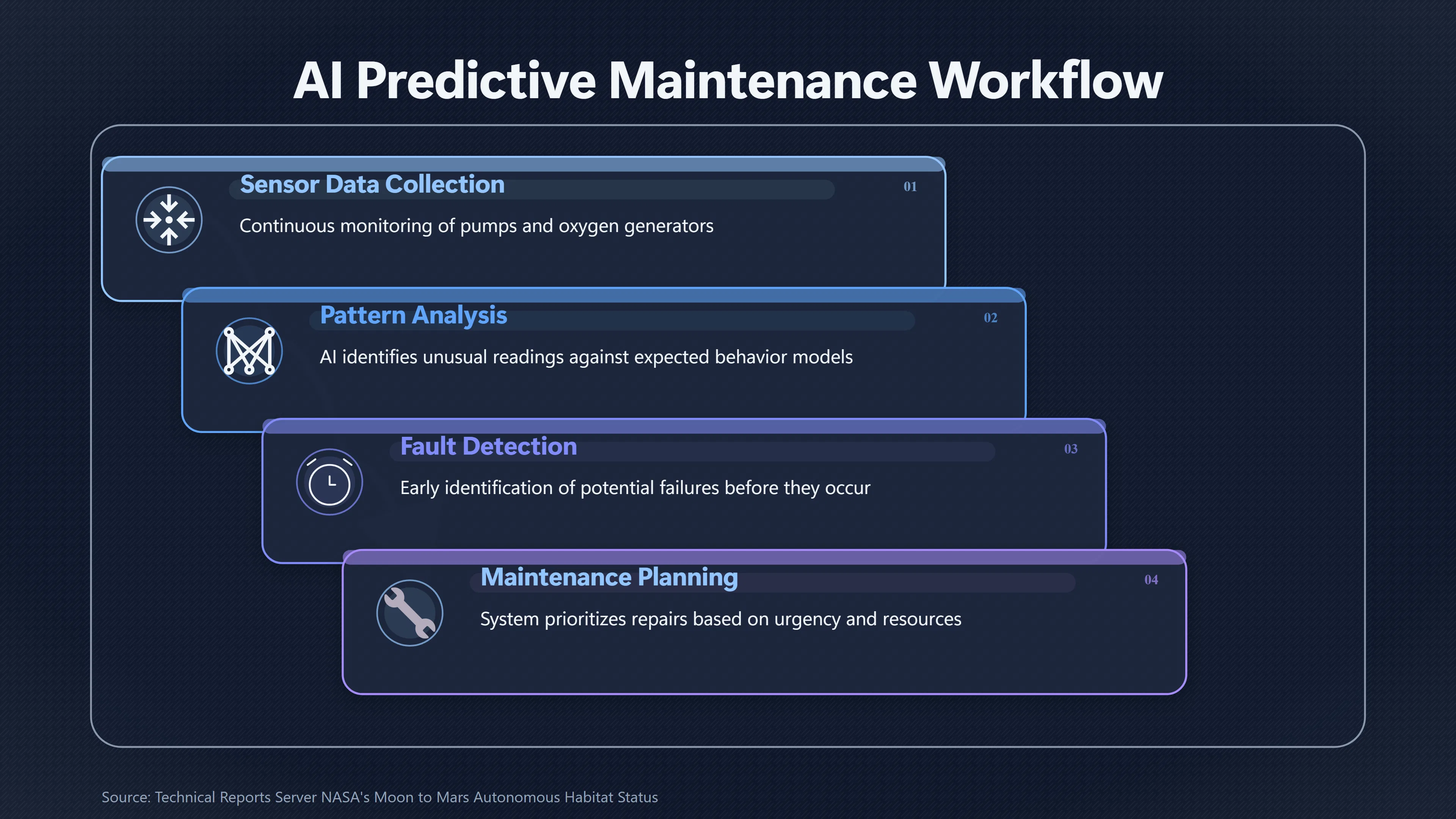
AI could improve these systems by acting as a continuous optimisation layer. Instead of waiting for a component to fail or for astronauts to notice a problem, an AI system could analyse sensor data from pumps, filters, oxygen generators, batteries and thermal systems to identify unusual patterns. It could recommend adjustments, prioritise maintenance tasks and help operators understand which failures are most urgent.
For a small crew hundreds of millions of kilometres from Earth, this matters because reliability is not only about preventing dramatic disasters. It is also about reducing thousands of small inefficiencies that consume limited time, energy and spare parts. A habitat that wastes less water, power or equipment life becomes easier to sustain.
Predicting failures before emergencies
The most valuable role for AI in space habitats may be preventing emergencies rather than responding to them. On Earth, engineers often rely on large maintenance teams, replacement parts and rapid access to specialist knowledge. A Mars settlement would not have those advantages. Communication delays and distance mean that crews may need to diagnose problems locally before receiving detailed support.[NASA Technical Reports Server]ntrs.nasa.govTechnical Reports Server NASA's Moon to Mars Autonomous Habitat StatusNASA Technical Reports ServerNASA's Moon to Mars Autonomous Habitat Status - NASA Technical Reports Server (NTRS)October 6, 2022…
Predictive maintenance uses data from machines to estimate when a component is becoming unreliable. Similar approaches are already used in industries such as aviation, manufacturing and energy, where unexpected equipment failure can be expensive or dangerous. In space, the stakes are higher because a failed pump, power unit or life-support component could threaten the entire habitat.
NASA’s plans for Moon and Mars habitation recognise that future systems must operate with limited resources, long mission durations and difficult emergency conditions. Habitats must combine monitoring, automation and robust design rather than depending on constant human intervention.[NASA Technical Reports Server]ntrs.nasa.govTechnical Reports Server NASA's Moon to Mars Autonomous Habitat StatusNASA Technical Reports ServerNASA's Moon to Mars Autonomous Habitat Status - NASA Technical Reports Server (NTRS)October 6, 2022…
AI could support this through several capabilities:
- Early fault detection: identifying unusual readings before they become failures.
- System modelling: comparing current habitat conditions with expected behaviour.
- Maintenance planning: helping crews decide which repairs should happen first.
- Resource optimisation: balancing power, water recycling and oxygen production during changing conditions.
- Knowledge support: helping astronauts troubleshoot unfamiliar problems when experts on Earth cannot respond immediately.
However, predictive AI has limits. A system can only recognise problems that are represented in its training data or sensor information. A rare failure, damaged sensor or unexpected environmental event may still require human judgement and traditional engineering solutions.
Why autonomy still needs human oversight
A common misunderstanding is that AI could make space habitats independent from humans. In practice, the safer goal is human-AI cooperation. Autonomous systems can handle monitoring, calculations and routine decisions, while humans remain responsible for priorities, ethical choices and unexpected situations.
NASA’s research into autonomous space systems follows this approach. AI has been explored for mission operations, spacecraft management and robotic assistance, with the aim of reducing workload and improving capability rather than removing humans from the system entirely.[arXiv]arxiv.orgarXiv Artificial Intelligence: Powering Human Exploration of the Moon and MarsArtificial Intelligence: Powering Human Exploration of the Moon and MarsOctober 7, 2019…
This distinction matters because reliability is not only a technical problem. A habitat must also deal with social and organisational challenges. Crew members need to understand why an AI system recommends an action, when to trust it and when to override it. Poorly designed automation could create new risks if operators lose situational awareness or cannot verify important decisions.
A reliable habitat would therefore likely combine:
- Automation for speed and consistency, such as monitoring hundreds of sensors continuously.
- Human judgement for unusual situations, where experience and creativity matter.
- Redundant systems, so that a single software error or hardware failure does not become catastrophic.
- Transparent AI tools, allowing crews to understand recommendations rather than blindly follow them.
Reliability is the foundation of survival expansion
AI-enabled habitats are important to the wider idea of expanding human civilisation because they address one of the hardest barriers to living beyond Earth: maintaining life in places where nature does not provide the necessary conditions. A settlement on the Moon or Mars cannot depend on constant rescue missions. It must become increasingly resilient.[NASA]nasa.govMoon to Mars ArchitectureMoon to Mars Architecture - Components - NASA…
The optimistic case for AI space habitats is therefore not that AI will eliminate the difficulty of settlement. Space will remain hostile, expensive and unforgiving. The stronger argument is that AI could help humanity build systems capable of operating safely for longer periods, with fewer failures and less dependence on Earth.
That reliability could become a stepping stone towards larger forms of human flourishing. If advanced AI helps create more dependable closed environments, autonomous infrastructure and resilient settlements, it could increase the range of places where humans can live and create. But the path depends on careful engineering, responsible governance and recognising that intelligence is only useful when it is embedded in systems designed for human survival.

Amazon book picks
Further Reading
Books and field guides related to How will AI keep space habitats alive?. Use these as the next step if you want deeper reading beyond the article.

Packing for Mars
Rating: 3.9/5 from 19 Google Books ratings
What happens to you when you can't walk for a year? When you can't have sex? Or smell flowers? What happens if you vomit in your helmet d...
The Case for Mars
He explains step-by-step how we can use present-day technology to send humans to Mars within ten years; actually produce fuel and oxygen...
A City on Mars
* THE INSTANT NEW YORK TIMES BESTSELLER * Winner of the Hugo Award * Scientific American’s #1 Book for 2023 * Winner of Royal Society's T...
The High Frontier
This expanded third edition features a new preface, introduction, and collection of essays by space researchers.
eBay marketplace picks
Marketplace Samples
Live-tested eBay searches with available results related to this page.
Selected fromspacecraft model oneBay.co.uk.
Endnotes
1.
Source: ntrs.nasa.gov
Title: Technical Reports Server NASA’s Moon to Mars Autonomous Habitat Status
Link:https://ntrs.nasa.gov/citations/20220015103
Source snippet
NASA Technical Reports ServerNASA's Moon to Mars Autonomous Habitat Status - NASA Technical Reports Server (NTRS)October 6, 2022...
Published: October 6, 2022
2.
Source: nasa.gov
Title: Moon to Mars Architecture
Link:https://www.nasa.gov/moontomarsarchitecture-components/
Source snippet
Moon to Mars Architecture - Components - NASA...
3.
Source: nasa.gov
Title: Life Support Subsystems
Link:https://www.nasa.gov/reference/jsc-life-support-subsystems/
Source snippet
January 22, 2026 — LIFE SUPPORT SUBSYSTEMS As a world leader in life support for human spaceflight, Johnson Space Center (JSC) offers...
Published: January 22, 2026
4.
Source: nasa.gov
Title: Environmental Control and Life Support Systems (ECLSS)
Link:https://www.nasa.gov/reference/environmental-control-and-life-support-systems-eclss/
Source snippet
Environmental Control and Life Support Systems (ECLSS) - NASAApril 4, 2025...
Published: April 4, 2025
5.
Source: nasa.gov
Title: Achieves Water Recovery Milestone on International Space Station
Link:https://www.nasa.gov/missions/station/iss-research/nasa-achieves-water-recovery-milestone-on-international-space-station/
Source snippet
NASA Achieves Water Recovery Milestone on International Space Station - NASA...
6.
Source: arxiv.org
Title: arXiv Artificial Intelligence: Powering Human [Exploration]({{ ‘explore-or-exploit/’ | relative_url }}) of the Moon and Mars
Link:https://arxiv.org/abs/1910.03014
Source snippet
Artificial Intelligence: Powering Human Exploration of the Moon and MarsOctober 7, 2019...
Published: October 7, 2019
7.
Source: techport.nasa.gov
Link:https://techport.nasa.gov/projects/113240
8.
Source: techport.nasa.gov
Link:https://techport.nasa.gov/projects/93167
9.
Source: nasa.gov
Title: Space Biosciences Bioengineering Branch at Ames
Link:https://www.nasa.gov/ames/space-biosciences/bioengineering-branch/
10.
Source: nasa.gov
Title: Crew Systems
Link:https://www.nasa.gov/reference/crew-systems/
11.
Source: nasa.gov
Link:https://www.nasa.gov/stennis/asl/
12.
Source: nasa.gov
Title: AE S Overview
Link:https://www.nasa.gov/aes-overview/
13.
Source: science.nasa.gov
Title: space age buoys for long duration monitoring of the moon
Link:https://science.nasa.gov/science-research/science-enabling-technology/technology-highlights/space-age-buoys-for-long-duration-monitoring-of-the-moon/
14.
Source: ntrs.nasa.gov
Link:https://ntrs.nasa.gov/citations/20220000524
15.
Source: ntrs.nasa.gov
Link:https://ntrs.nasa.gov/archive/nasa/casi.ntrs.nasa.gov/20200003267.pdf
16.
Source: nasa.gov
Link:https://www.nasa.gov/centers-and-facilities/marshall/life-support-upgrades-arrive-at-station-improve-reliability-for-moon-mars-missions/
17.
Source: nasa.gov
Title: Habitats Optimized for Missions of Exploration (HOME)
Link:https://www.nasa.gov/directorates/stmd/space-tech-research-grants/habitats-optimized-for-missions-of-exploration-home/
18.
Source: nasa.gov
Title: The Marshall Star
Link:https://www.nasa.gov/centers-and-facilities/marshall/the-marshall-star-242/
19.
Source: nasa.gov
Title: The Bare Necessities: Surviving the Rigors of Space Travel
Link:https://www.nasa.gov/centers-and-facilities/marshall/the-bare-necessities-surviving-the-rigors-of-space-travel/
20.
Source: ntrs.nasa.gov
Link:https://ntrs.nasa.gov/citations/20110013479
21.
Source: ntrs.nasa.gov
Link:https://ntrs.nasa.gov/archive/nasa/casi.ntrs.nasa.gov/20050207456.pdf
22.
Source: science.gsfc.nasa.gov
Link:https://science.gsfc.nasa.gov/sci/projects/635/
23.
Source: technology.nasa.gov
Title: autonomous systems [robotics]({{ ‘robotics/’ | relative_url }})
Link:https://technology.nasa.gov/advancing-commercial-space/autonomous_systems_robotics
24.
Source: science.gsfc.nasa.gov
Link:https://science.gsfc.nasa.gov/solarsystem/projects/635
25.
Source: science.gsfc.nasa.gov
Link:https://science.gsfc.nasa.gov/astrophysics/projects/635
26.
Source: science.gsfc.nasa.gov
Link:https://science.gsfc.nasa.gov/solarsystem/astrochemistry/projects/635/
Additional References
27.
Source: sciencedirect.com
Link:https://www.sciencedirect.com/science/article/pii/S2950616625000427
Source snippet
March 1, 2026 — SPACE HABITATION Volume 2, Issue 1, March 2026, 100044 SPACE HABITATION: MACHINE LEARNING BASED EVALUATION A...
Published: March 1, 2026
28.
Source: kth.se
Link:https://www.kth.se/en/seed/forskning/pagaende-forskningsp/pagaende-forsknings-projekt/the-effects-of-ai-based-predictive-maintenance-from-life-cycle-perspective-1.1479678
Source snippet
The effects of AI based predictive maintenance from life cycle perspective | KTHJune 2, 2026 — * * * * # The effects of AI based predicti...
Published: June 2, 2026
29.
Source: youtube.com
Link:https://www.youtube.com/watch?v=sxPXHuKPQn8
Source snippet
AI at NASA: Unlocking the Future of Exploration...
30.
Source: youtube.com
Title: Artificial Intelligence, Exoplanets, & the Future of Astrobiology
Link:https://www.youtube.com/watch?v=Lt50527eHjU
Source snippet
How AI Is Revolutionizing the Space Industry...
31.
Source: sciencedirect.com
Link:https://www.sciencedirect.com/science/article/abs/pii/S0094576525006654
32.
Source: sciencedirect.com
Link:https://www.sciencedirect.com/science/article/pii/S0094576525006654
33.
Source: escholarship.org
Link:https://escholarship.org/uc/item/8992x9nb
34.
Source: doi.org
Link:https://doi.org/10.32865/2346/102642
35.
Source: colab.ws
Link:https://colab.ws/articles/10.1016/j.lssr.2025.06.001
36.
Source: youtube.com
Title: From Earth to Mars: How NASA Uses AI
Link:https://www.youtube.com/watch?v=q6VDPqRQo90
Source snippet
Artificial Intelligence, Exoplanets, & the Future of Astrobiology...